Dhaka's 53% Middle East flight capacity lost in 11 days
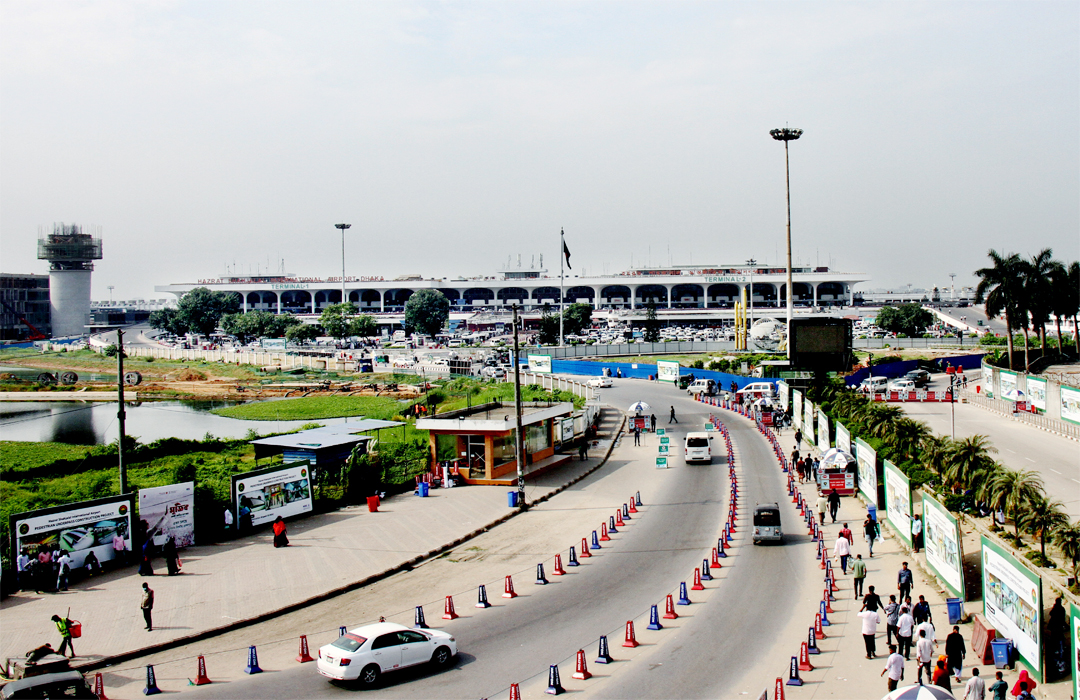
Image: Oheduzzaman Titu
More than half of all
planned Middle East flights from Dhaka did not took off. In11 days between
February 28 and March 10, 367 flights were cancelled at Hazrat Shahjalal
International Airport (Dhaka airport), surpassing the 325 that actually
operated, as 7 Gulf nations simultaneously sealed their airspaces amid a
deepening regional security crisis.
On Tuesday, this was
informed through a press release sent by Muhammad Kawsar Mahmud, Assistant
Director (Public Relations) of Civil Aviation Authority of Bangladesh (CAAB).
Data reveal a clear and
measurable trend. 53% capacity collapse, 9 airlines grounded in part, and a
sufficiency rate that fell to roughly one seat available for every two
passengers who needed one. But behind the statistics are the people who paid
the real price. Bangladeshi migrant workers stranded mid-journey, families separated
during Ramadan, and labourers unable to return to the Gulf jobs on which
millions of households back home depend. The airspace closed in a matter of
hours. The consequences will take far longer to clear.
Key metrics at a glance
|
Metric |
Value |
|
Planned / operated flights |
325 |
|
Cancelled flights |
367 |
|
Implied total demand |
~692 |
|
Sufficiency rate |
~47% |
|
Cancellation rate |
~53% |
|
Airlines affected |
9 carriers |
|
Period |
11 days |
On February 28, 7
Middle Eastern countries, Iran, Iraq, Kuwait, the United Arab Emirates,
Bahrain, Qatar, and Jordan, simultaneously closed their airspaces following a
deteriorating regional security situation. Closures struck at the heart of one
of Bangladesh’s most critical aviation corridors, connecting the country to the
Gulf region, which hosts over 50 lakh Bangladeshi expatriate workers.
Scale of disruption
Over the 11-day
period from February 28 to March 10, Hazrat Shahjalal International Airport
(HSIA) recorded 367 flight cancellations, a figure that exceeded the 325 Middle
East flights that actually operated during the same window. This means that
cancellations outnumbered completions, producing a sufficiency rate of
approximately 47%. Put differently, for every two passengers who successfully
departed, roughly two others were left stranded.
The disruption was
not evenly distributed. Cancellations began at 23 on February 28 and peaked
sharply at 46 on March 2, before tapering to 28–39 per day through the first
week of March. The second week maintained a similarly elevated level, with
28–36 daily cancellations and 33 recorded on March 9 alone.
Supply-side response
Of the 325 flights
that operated, Saudi Arabia absorbed the largest share with 183 departures,
followed by UAE destinations (73 flights to Dubai, Sharjah, and Abu Dhabi) and
Oman (69 flights to Muscat). These routes skirted the most severely restricted
airspaces and allowed partial connectivity to be maintained. Operations ramped
up from just 6 flights on February 28 to 42 on March 10, the highest single-day
count, suggesting airlines progressively identified viable routing
alternatives.
Despite this ramp-up,
the supply response remained insufficient. Even on March 10, with 42 flights
operated, 32 cancellations were still recorded, indicating that airspace
restrictions remained substantially in force and that scheduling optimism
outpaced actual operational clearance.
Airline and passenger impact
Nine airlines were
affected including Kuwait Airways, Air Arabia, Gulf Air, Qatar Airways,
Emirates, Jazeera Airways, flydubai, Biman Bangladesh, and US-Bangla. On March
10 alone, each of Air Arabia, Gulf Air, Qatar Airways, Emirates, Jazeera
Airways, and flydubai cancelled 4 flights, while both Biman Bangladesh and
US-Bangla cancelled three flights each.
The human cost was
disproportionately borne by Bangladeshi migrant workers, Ramadan travellers,
and families with Gulf connections, groups with limited financial flexibility
to absorb rebooking costs or extended delays. The timing of the crisis,
coinciding with peak Ramadan travel and the return of workers after winter
holidays, amplified the socio-economic toll significantly.
Air connectivity
between Dhaka and the Middle East operated at roughly half its intended
capacity across the 11-day crisis window. With 367 cancellations against 325
operated flights, the supply of seats was critically insufficient to meet
demand. Full normalization remains contingent on the lifting of regional
airspace restrictions, which, as of Tuesday, continued to affect operations
across multiple carriers and destinations.

Make Comment
Login to CommentPopular News





Subscribe to News Letter
Latest News