SAFETY RECKONING
ICAO Audit Pushed to October 2027
Delay buys time, not safety, CAAB seeks reforms, independence
 Senior Reporter
| Published: Sunday, June 07, 2026
Senior Reporter
| Published: Sunday, June 07, 2026
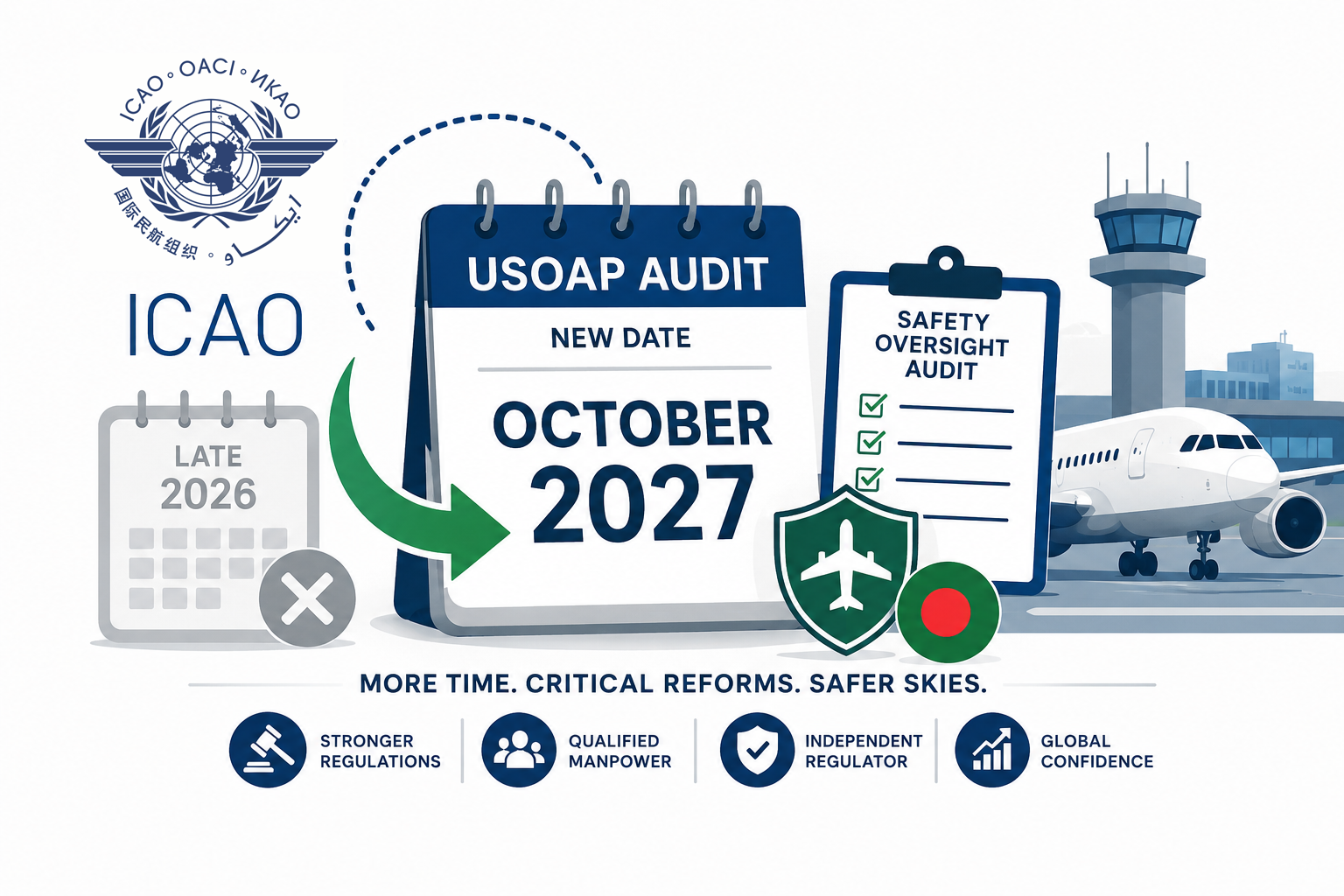
The International Civil Aviation Organization (ICAO) has pushed Bangladesh's long-awaited Universal Safety Oversight Audit Programme (USOAP) audit to October 2027, giving the Civil Aviation Authority of Bangladesh (CAAB) nearly two additional years to address critical regulatory shortcomings that could otherwise expose the country's aviation sector to serious international consequences.
Multiple CAAB officials told Aviation Express that the regulator itself had unofficially sought the deferment, as it was not fully prepared to face the audit originally scheduled for late 2026.
To prepare for the assessment, CAAB has requested ICAO to conduct a pre-audit support mission in December this year. The mission is expected to identify existing deficiencies and recommend corrective measures before the formal audit begins.
While the postponement has provided temporary relief, aviation experts warn that the delay merely postpones a critical examination of Bangladesh's aviation oversight system.
Unlike routine inspections, ICAO's USOAP audit evaluates a country's entire regulatory framework, including legal authority, institutional independence, technical capability, qualified manpower and safety oversight mechanisms.
A poor outcome could result in a Significant Safety Concern (SSC), ICAO's most serious finding against a national aviation regulator.
Industry insiders say the consequences of an SSC could be severe. CAAB's ability to approve additional aircraft for local carriers could come under international scrutiny or face restrictions, potentially disrupting fleet expansion plans of Biman Bangladesh Airlines, US-Bangla Airlines and Novoair.
International aircraft leasing companies could also become increasingly reluctant to place aircraft in Bangladesh if confidence in the country's regulatory oversight weakens.
"Lessors look at regulatory credibility before placing multimillion-dollar assets in any country," an aviation expert said. "If ICAO raises serious concerns, Bangladesh instantly becomes a higher-risk market."
Such a scenario could lead to higher leasing costs, stricter financing conditions, increased security deposits and reduced access to aircraft. Industry officials further warned that some foreign aviation authorities could impose additional scrutiny on Bangladeshi airlines, while certain countries might reconsider operating permissions until regulatory deficiencies are resolved.
CAAB officials, however, remain cautiously optimistic about passing the audit in 2027, provided key reforms are implemented without delay.
According to officials, CAAB has already submitted proposals to the Ministry of Civil Aviation and Tourism seeking amendments to existing legislation. Regulatory independence remains at the centre of those proposals.
Officials argue that the CAAB chairman must be granted greater operational autonomy to function as a fully independent regulator in line with international standards.
"The audit will examine whether the regulator can make decisions independently and effectively discharge its oversight responsibilities," a CAAB official said.
The regulator is also seeking changes to its organisational structure and improved incentives to attract and retain qualified inspectors, engineers and technical specialists. Shortages of skilled manpower continue to be one of CAAB's most persistent challenges.

Make Comment
Login to CommentPopular News





Subscribe to News Letter
Latest News