
25-year US-Bangladesh cultural partnership restores Musa Khan Mosque
প্রকাশ: মঙ্গলবার । মার্চ ৩১, ২০২৬
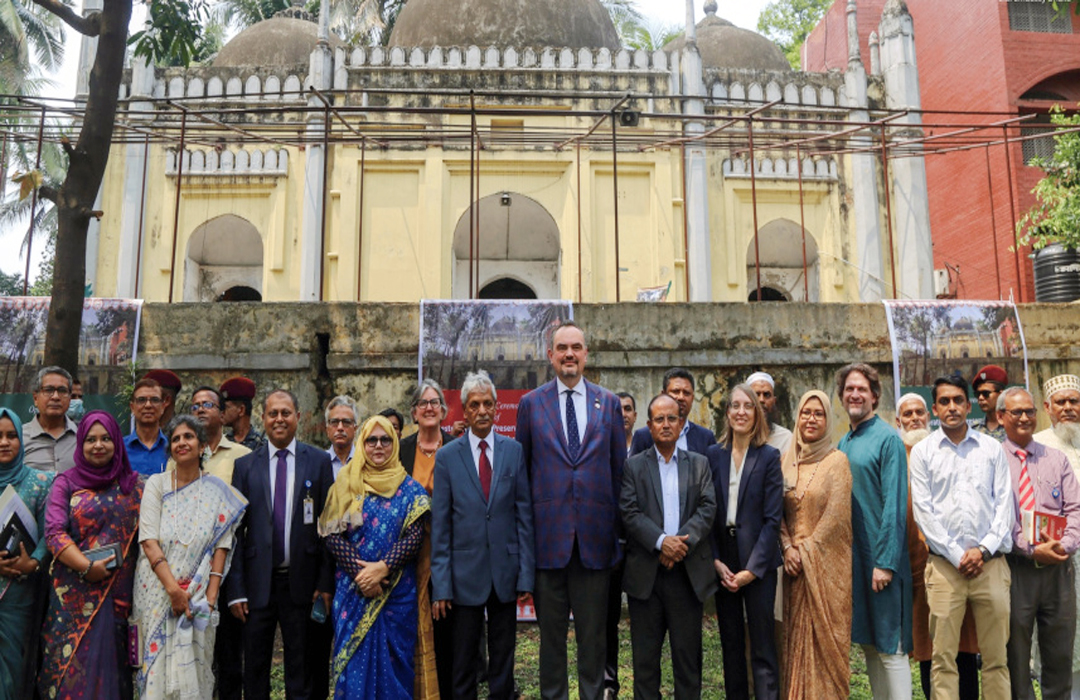
The ochre light of a Dhaka afternoon filters through the gaps in the crumbling dome. Inside the Musa Khan Mosque, centuries have left their mark—not in stories or songs, but in fractured brickwork, in walls that sag like the shoulders of old men, in archways that once framed devotion now framing nothing but vacancy. This is what time does to monuments when no one is watching.
But someone, it turns out, has been watching.
At Curzon Hall on Tuesday, US Ambassador Brent T Christensen stood beside Cultural Affairs Minister Nitai Roy Chowdhury and announced what might sound like just another diplomatic handshake as they will give USD 2 lakh 35 thousand (TK 2 crore 89 lakh 42 thousand 600) grant from the Ambassadors Fund for Cultural Preservation to restore the Mughal-era Mosque. The press clicked photos. Officials smiled. The ritual of international cooperation played out as scripted.
Yet beneath the formality lies something more intimate, a quiet acknowledgment that heritage is not just about the past. It is about who we are now, and what we choose to remember.
The Musa Khan Mosque is not a household name, even in Dhaka. It does not draw the tourist crowds of Lalbagh Fort or the Ahsan Manzil. But for those who know their city's layered history, it is a whisper from the Mughal twilight, a fragment of an empire that once stretched from the ramparts of Agra to the riverine sprawl of Bengal. Named after Musa Khan, a 17th-century zamindar who resisted Mughal expansion with stubborn ferocity, the mosque embodies a peculiar contradiction: Mughal architecture consecrated in the name of a man who defied the Mughals themselves.
That paradox, in a way, is deeply Bangladeshi. We are a nation built on layers. on conquest and resistance, on syncretism and survival.
The restoration project, as outlined by Poornima Rai, spokesperson for the US Mission, is not just about repairing walls. It is a three-pronged intervention: physical restoration to stabilize the structure and revive its Islamic architectural features; the creation of a permanent digital archive to document every arch, every inscription, every fading floral motif; and a training programme to equip young Bangladeshi architects with the skills to carry this work forward.
That last part matters most. Heritage conservation in Bangladesh has long suffered from a tragic asymmetry, plenty of monuments, not enough trained hands to save them. The Department of Archaeology, led by Director General Sabina Alam, has done what it can with limited resources, but the scale of decay often outpaces institutional capacity. Dhaka alone is littered with Mughal, colonial and pre-colonial structures quietly disintegrating under the twin pressures of monsoon humidity and urban neglect.
This is where the US-Bangladesh cultural partnership, now 25 years old and encompassing 13 projects worth over USD 1 crore, enters the frame. It is easy to be cynical about such collaborations, to reduce them to the transactional grammar of diplomacy. But strip away the platitudes, and what remains is a shared conviction that some things are worth saving, not because they are useful, but because they are irreplaceable.
The digital archive component is particularly resonant in an age when memory is increasingly mediated by screens. Imagine a researcher in Chattogram, a heritage enthusiast in Sylhet, or a student in rural Barishal being able to virtually walk through the Musa Khan Mosque, to zoom into the delicate stucco work, to trace the Quranic inscriptions that time has nearly erased. This is preservation not as museum practice, but as living pedagogy.
Still, questions linger. The embassy has not yet disclosed a timeline or specific restoration phases. Will the work be completed in years or decades? Will the mosque be accessible to the public during restoration, or will it vanish behind scaffolding for an indefinite stretch? And crucially, once restored, how will it be maintained? History is full of beautifully restored monuments that, within a generation, slide back into neglect.
These are not criticisms so much as hopes, for transparency, for sustainability, for a restoration that does not end when the cameras leave.
In the end, the Musa Khan Mosque is more than bricks and mortar. It is a question we must answer: What kind of city, what kind of country, do we want to be? One that remembers, or one that forgets? One that preserves its plural past, or one that allows it to crumble into convenient amnesia?
The stones are speaking. The question is whether we are listening.