
9 days of turbulence; 300 flights vanish from Dhaka’s schedule
প্রকাশ: রবিবার । মার্চ ০৮, ২০২৬
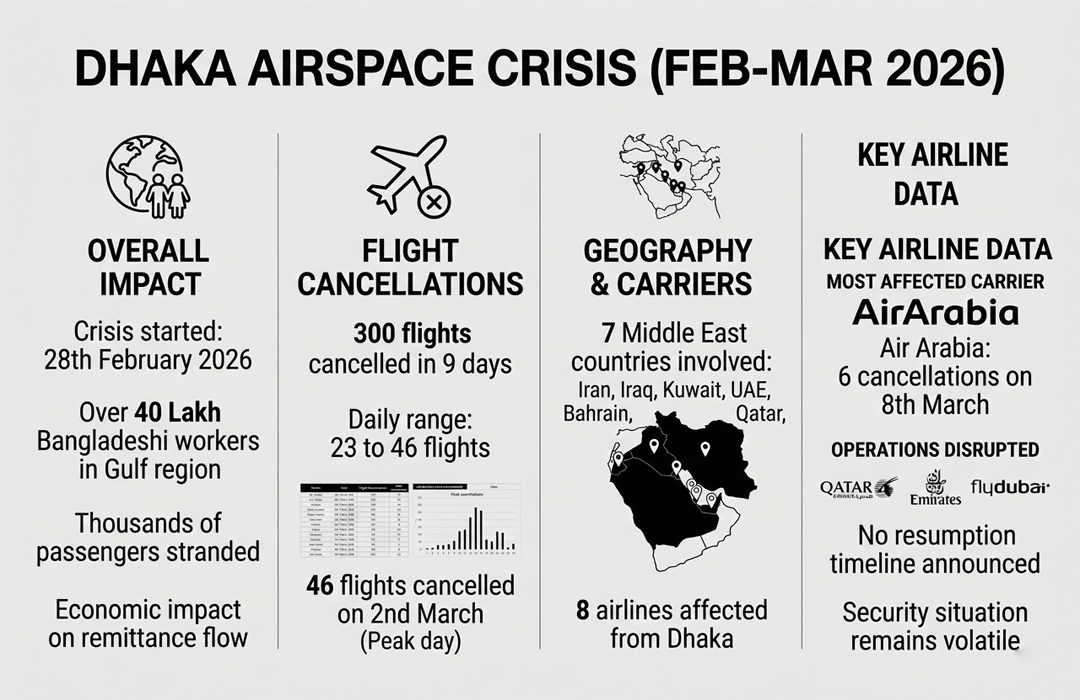
Middle Eastern security crisis has forced cancellation of 300 flights from Hazrat Shahjalal International Airport (Dhaka airport) since February 28, as 7 countries closed their airspace amid escalating regional tensions.
On Sunday, this was informed through a press release sent by Muhammad Kawsar Mahmud, Assistant Director (Public Relations) of Civil Aviation Authority of Bangladesh (CAAB).
Iran, Iraq, Kuwait, United Arab Emirates, Bahrain, Qatar and Jordan shut their airspace on February 28 due to security situation in the region. This immediately disrupted flight operations connecting Bangladesh with Middle East destinations.
Flight cancellations began with 23 on February 28 and peaked at 46 on March 2. Daily cancellations remained high with 40 flights on March 1, 39 on March 3, 28 on March 4, 36 on March 5, 34 on March 6, 28 on March 7 and 26 on March 8.
8 airlines operating from Dhaka have been affected by airspace closure. Kuwait Airways cancelled 2 flights on March 8, while Jazeera Airways from Kuwait cancelled 4. Air Arabia operating from Sharjah in UAE cancelled 6 flights, making it the most affected carrier.
Gulf Air from Bahrain cancelled 2 flights while Qatar Airways cancelled 4. Emirates Airlines and Flydubai, both based in UAE, cancelled 4 and 2 flights respectively. Saudia Airlines operating from Riyadh cancelled 2 flights on March 8.
Total cancellations for March 8 reached 26 flights, bringing cumulative total to 300 since crisis began. Airspace restrictions continue to affect thousands of Bangladeshi passengers travelling for work, religious purposes and family visits to Middle East.
Bangladesh maintains strong economic ties with Gulf nations, with over 50 lakh Bangladeshi workers employed across the region. Remittance flow and travel disruptions from airspace closure could impact bilateral relations and economic activities.
Airlines have not announced when normal operations will resume, as situation in Middle East remains volatile. Passengers are advised to contact respective airlines for updates on rescheduling and refund policies.