
A night walk through Old Dhaka’s delights
প্রকাশ: সোমবার । ফেব্রুয়ারি ০২, ২০২৬
By Muhammad Hasan Pallab
As Dhaka looks toward a future of smart cities and lifestyle districts, one ancient artery of the capital continues to thrive on memory, spice and human connection. Nazirabazar—without an official title or signage—has quietly evolved into Bangladesh’s most organic example of culinary tourism, where tradition fuels tomorrow’s travel economy.
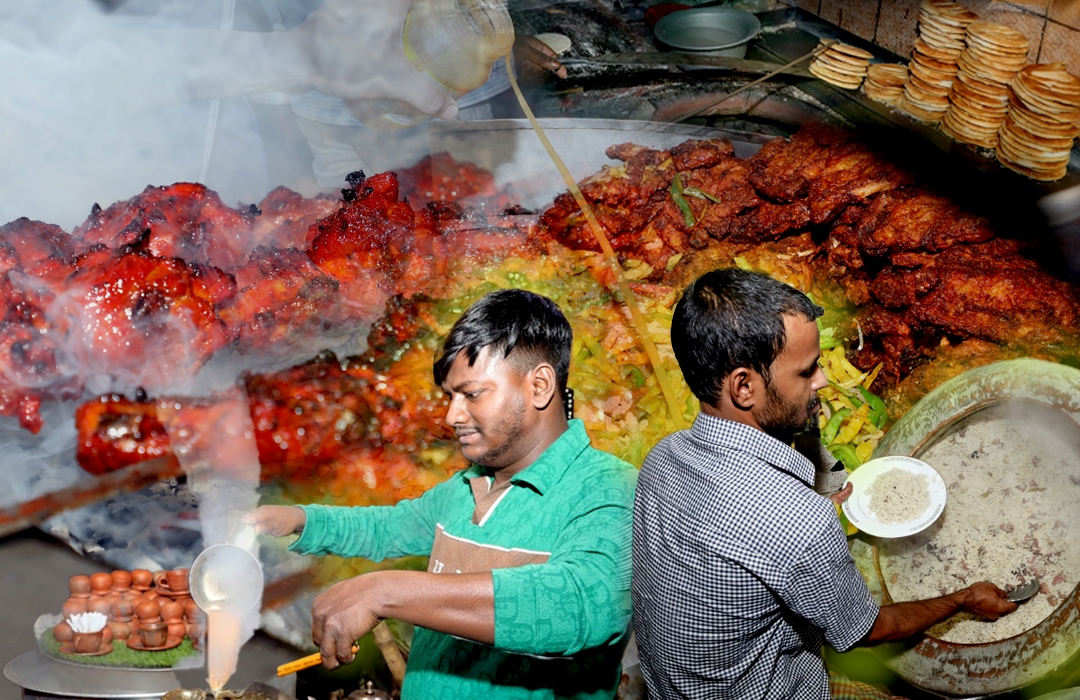
When night falls, Nazirabazar awakens. The deeper the night, the stronger the pull. Steam rises from copper pots, charcoal fires glow beneath skewers, and the air thickens with the scent of kacchi biryani, beef kebab and freshly churned lassi. What was once a local food strip has become a pilgrimage for food lovers from across Bangladesh and an increasing number of foreign visitors seeking an authentic Old Dhaka experience.
Though never formally designated, Nazirabazar functions as a living food street—one that bridges the historical core of Old Dhaka with the expanding urban sprawl of New Dhaka. For many residents of Gulshan, Banani or Mirpur, this narrow road is their first real encounter with Old Dhaka’s layered culture, arriving not through monuments, but through taste.
Where heritage meets appetite
Unlike heritage districts built around architecture or museums, Nazirabazar’s identity is edible. Its appeal lies not in grand landmarks, but in continuity. Generations-old kitchens operate beside modern counters. A 10-taka cup of tea competes effortlessly with air-conditioned dining. The result is a rare culinary ecosystem where past and present coexist without friction.
From the Fulbaria Fire Service Road entrance, visitors begin a sensory walk. On the right stands Hotel One Star, serving rice platters, fish, meat, chicken polao, kacchi biryani, lassi and faluda—often the first stop for newcomers. Just a few steps ahead, the legendary Beauty Lassi, established in 1922, anchors the street’s emotional memory. Its thick, velvety lassi—alongside malai lassi and faluda—draws long nightly queues of locals, students, tourists and foreign visitors alike.
Opposite Beauty Lassi, Pannu Khan’s Tea Stall spills onto the pavement, offering its iconic 10-taka tea, while nearby rice and bread shops keep the street alive with constant movement. Further along, history simmers at Haji Biryani, founded in 1939, where worn tables and chairs tell stories of decades past. Across the road, Adi Haji Biryani carries the name, while next door Hanif Biryani has built its own loyal following, particularly for mutton biryani.
As the road stretches on, Alauddin Sweets appears on the left, while Bukhari Biryani and Haji Nanna Biryani on the right are known for basmati kacchi biryani, chicken polao, borhani and milk-almond sherbet. Soft ice-cream counters punctuate the scene, drawing families and children late into the night.
A festival that never ends
At the Nazirabazar intersection, smoke and spice dominate. Traditional kebab houses—Bismillah Kebab and Badshahi Kebab—sizzle with beef chap, chicken chap, gurda and boti kebab, while nearby bakarkhani stalls remind visitors that bread here is not an accessory, but a ritual.
Turning right onto Bangladesh Field Road, the focus shifts to beef tehari. Shops such as Mamun Biryani, Moti Biryani, Madina Biryani, Khushbu Biryani and Kashmir Biryani compete in aroma and reputation. New Dhaka’s Tehari Ghar has also found acceptance here, its mustard-oil-infused tehari winning over even Old Dhaka regulars.
For diners seeking comfort without leaving the area, air-conditioned restaurants like Grand Nawab and Taste of Nawab offer private seating, seafood and marine barbecue. Around them, dozens of small outlets serve tea, coffee, milkshakes, soft drinks and more than 20 varieties of traditional and fire-roasted paan.
The future of a nameless street
Nazirabazar’s greatest asset is atmosphere. On Thursday and Friday nights, and on holiday eves, the street becomes an open-air festival. Families stroll, food vloggers film content, strangers share tables and laughter flows as freely as borhani.
“Almost all traditional Old Dhaka foods are available here,” said Ruhul Amin from Gulshan. “Nobody leaves hungry. Beyond the food, the atmosphere is festive and welcoming—something New Dhaka restaurants can’t replicate.”
For Mouri Dola from Badda, accessibility matters. “You can drive up to Fulbaria and walk. Nazirabazar sits perfectly between Old and New Dhaka.”
Local businessman Aynal Hossain believes the area is ready for formal recognition. “People now come from other districts, stay through the night and return safely. An official food-street designation would allow shops to operate legally at night and improve management.”
A dedicated parking facility near Abdullah Tower is already under development—a small but meaningful step.
In a future where culinary tourism shapes urban travel, Nazirabazar offers Dhaka a ready-made blueprint—authentic, inclusive and alive. Nameless on paper, it is already famous, one plate and one night at a time.