
Air India launches new cargo transshipment system
প্রকাশ: শনিবার । আগস্ট ২২, ২০২৬
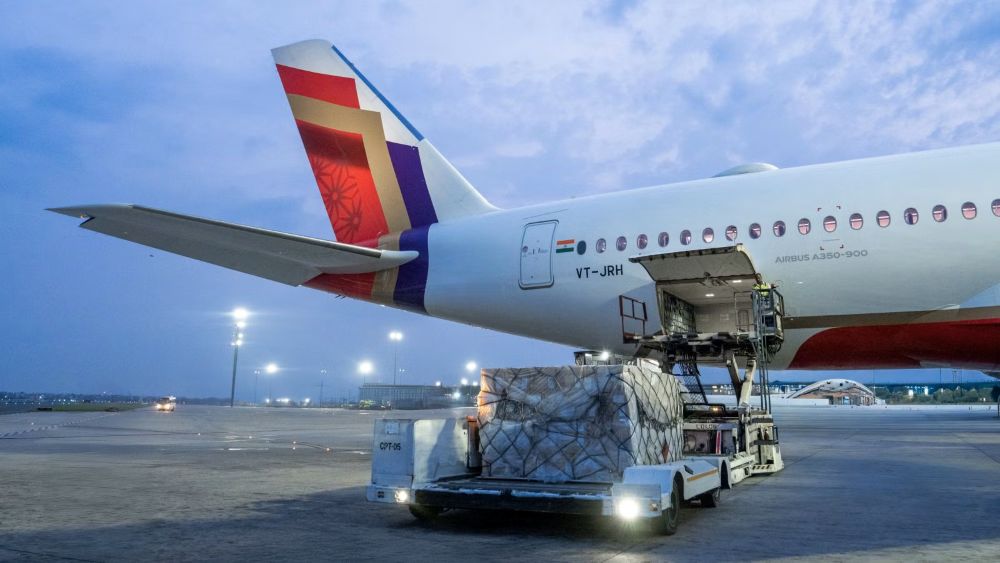
Air India has become the first Indian carrier to operationalise the government's new cargo transshipment policy, the airline said, reporting sharp reductions in cargo transit times on a pilot corridor linking Chennai, Delhi, and Frankfurt as the project is expanded to additional India-Europe routes.
The airline said the Proof of Concept, launched on June 20, 2026 and approved by the Bureau of Civil Aviation Security (BCAS), allows eligible cargo to remain sealed within the same unit load device throughout its journey, removing the requirement for piece-level re-screening at the transit point.
Under the earlier process, shipments had to be unpacked and each package individually re-screened at Delhi before being rebuilt and loaded onto the onward flight, adding delays and increasing the risk of damage or discrepancies, Air India said.
Over the two months since launch, the airline said average cargo volumes on the Chennai-Delhi-Frankfurt corridor doubled, from 2.2 metric tonnes to 4.5 metric tonnes per day, while a total of 300 metric tonnes moved from Chennai to Frankfurt via Delhi between June 20 and August 20.
Average cargo connection time at Delhi airport fell from 36-48 hours to 5-8 hours, the airline said, adding that on-time performance for booked cargo improved from 76 percent to 100 percent, with no cargo loss or damage recorded during the trial.
Following government approval to widen the pilot, Air India said it will extend seamless cargo movement via Delhi to shipments originating in Ahmedabad, Bengaluru, Chennai, Hyderabad, and Mumbai, connecting onward to Copenhagen, Frankfurt, and London Heathrow.
P.Balaji, Air India's group head for governance, risk, compliance, and corporate affairs, linked the initiative to the government's broader push to build cargo and logistics capacity, saying it would help position Indian airports as more competitive transit hubs and strengthen the wider logistics chain.
He thanked the Ministry of Civil Aviation, BCAS, and other stakeholders for supporting the project.
Ramesh Mamidala, Air India's head of cargo, said the policy could prove significant for India's air cargo sector by drawing transit traffic that currently moves through overseas hubs and improving aircraft belly-hold utilisation across the airline's network.
He said Delhi alone had the potential to attract more than 2 million metric tonnes of additional annual transshipment cargo across more than 95 international air cargo corridors, with benefits extending to freight forwarders, e-commerce, warehousing, and ground-handling firms.
Air India said the policy would, subject to regulatory approval, be progressively extended to cover all domestic-to-international cargo movements, including narrowbody bulk cargo, as well as international-to-domestic and international-to-international transshipment through Indian airports.
Source: PR