
ATR targets growth with new assembly line though supply chain constraints linger
প্রকাশ: রবিবার । ফেব্রুয়ারি ২২, ২০২৬
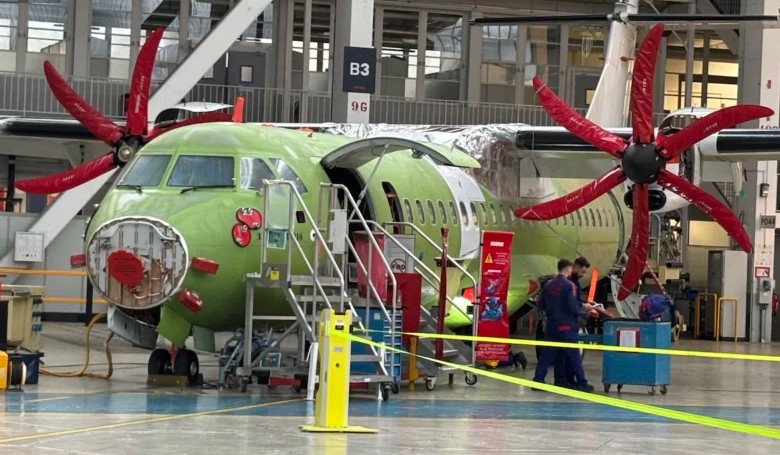
ATR reported €1.2 billion in revenue for 2025, right as the turboprop aircraft maker is gearing up to ramp up production in 2026.
At a press conference held at the company’s premises in Toulouse, France, on February 18, 2026, ATR’s Chief Executive Officer (CEO), Nathalie Tarnaud Laude, expressed her satisfaction regarding the firm’s performance in the past year, even though deliveries totaled 32 aircraft, slightly lower than the 35 it delivered the preceding year.
The French executive blamed supply chain constraints, particularly in areas such as landing gears and engines, for this limited output.
Nevertheless, she highlighted that demand remains strong. In 2025, ATR registered net orders for 50 aircraft (60 new orders and 10 cancellations, the latter due to an undisclosed customer undergoing internal reorganization). These include the largest single orders received by ATR since 2017, from Uni Air of Taiwan and Algerian flag carrier Air Algérie, for 19 and 16 aircraft, respectively. 2025 was also the second year in a row that ATR surpassed the 50-order mark in new orders (it sold 51 aircraft in 2024).
ATR is, in fact, so confident in the robustness of demand that it is reactivating a second-final assembly line at its industrial site in Blagnac, Toulouse. This additional line, which had been running until 2018, will be active again by May 2026. This will allow the company to increase its deliveries by 20% in 2026, eventually reaching 60 per year.
Also present at the press briefing was Marion Smeyers, ATR’s SVP of Procurement and Operations, who explained how fixing the supply chain issues had been a top priority for ATR throughout 2025. The aircraft manufacturer had worked closely with Tier 1 suppliers to optimize its manufacturing operations and has also been supporting some Tier 2 and Tier 3 suppliers in delicate financial situations.
Smeyers shared that ATR had the goal of reducing production times by 40%, defined as the amount of time that passes from the moment sub-assemblies arrive at the Toulouse plant to the delivery of the aircraft. So far, the firm has achieved a reduction of 20%. “We are half of the way there,” Smeyers added.
Growth markets
When it comes to ATR’s commercial outlook, the firm’s Commercial Director, Alexis Vidal, highlighted the interesting opportunity represented by the North American market. In the next decade, he explained, some 300 regional jets will need to be replaced. According to Vidal, there isn’t any other platform in the market as efficient as ATR’s turboprops for the type of mission that CRJs currently perform in the US.
Vidal went on to explain how ATR had acquired lots of anonymized geolocated data, which made it possible to better understand mobility patterns throughout the US. “We are not just making planes; we are in the mobility business,” he stated.
He also explained how the abandonment of many regional routes in the US (from around 1,400 to 800 city pairs in the last few years) is in part a consequence of aircraft upgauging by airlines. The business case for ATR is that by bringing an aircraft able to operate these routes economically to the market, there will be an opportunity for some operators to restart these routes.
In this regard, premium operator JSX acts as a sort of showcase for turboprop operations in the US, a market that has traditionally overlooked this type of aircraft in favor of jets.
Working on clean propulsion
Looking ahead, ATR also confirmed plans to continue investing in clean flight technology. The manufacturer is a leading partner in two programs supported by the European Clean Aviation Joint Undertaking.
These include the HERACLES program, which is working on a super-efficient regional aircraft that can use both high-performance batteries and a thermal engine running on 100% Sustainable Aviation Fuel, and the DEMETRA program, which is testing a hybrid-electric ATR72-600 aircraft.
The validation of these technologies will be key to the future of low-emission EVO aircraft, which are expected to fly by the end of 2029 and have a target entry-in- service date of 2035. ATR expects to be in a position to make a final decision on the future of this project in 2029.
“Clean aviation project is the main project for ATR; it is a very important step for building the future of the company," Tarnaud Laude commented on this project.
Source: aerotime