
Bangladesh pushes practical roadmap to revive SAARC
প্রকাশ: সোমবার । জুলাই ০৬, ২০২৬
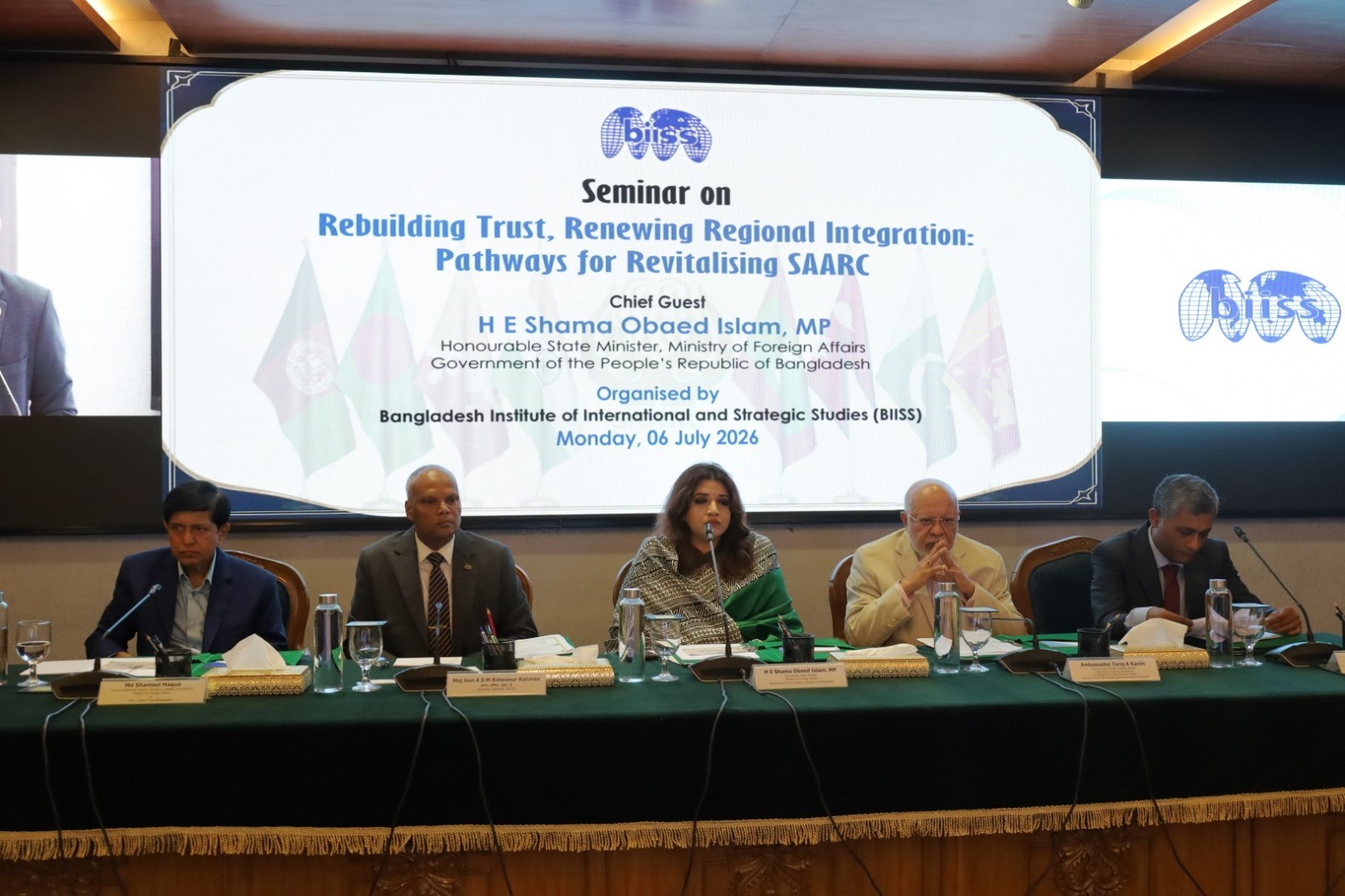
Declaring that South Asia's premier regional organisation now needs "wise leadership, practical cooperation and renewed confidence," State Minister for Foreign Affairs Shama Obaed Islam on Monday signalled Bangladesh's readiness to take a leading role in reviving the long-stalled SAARC through a pragmatic, step-by-step approach rather than waiting for ideal political conditions.
Addressing a seminar on "Rebuilding Trust, Renewing Regional Integration: Pathways for Revitalising SAARC" at the Bangladesh Institute of International and Strategic Studies (BIISS), the state minister outlined what appears to be the government's most comprehensive roadmap yet for restoring momentum to the South Asian Association for Regional Cooperation (SAARC).
"SAARC is waiting for wise leadership, practical cooperation and renewed confidence. Bangladesh is ready to contribute to that confidence," she said.
Her remarks come as Dhaka seeks to reinvigorate regional diplomacy under the government's "Bangladesh First" foreign policy, with renewed emphasis on connectivity, trade, climate resilience and economic cooperation.
A pragmatic revival strategy
Acknowledging that SAARC has remained politically paralysed for years, Shama argued that the organisation should not wait for complete political normalcy before resuming meaningful cooperation.
Instead, Bangladesh favours allowing SAARC to function at what she described as an "optimal functional level" until conditions become conducive for a full political and summit-level revival.
"It does not mean keeping SAARC alive only symbolically," she said.
"It means doing the maximum that is realistically possible under current circumstances—being ambitious in spirit but realistic in methods."
Under such an approach, she said, SAARC should hold regular technical and official meetings, strengthen its specialised bodies, pursue cooperation in non-contentious sectors and produce visible outcomes for the people of South Asia.
Bangladesh also supports flexible, project-based cooperation, allowing willing member states to move ahead with practical initiatives while leaving the door open for others to join later.
From intent to action
The state minister revealed that since the present government assumed office nearly four months ago, she has held separate discussions with every SAARC member state regarding the organisation's future.
According to her, all member countries expressed a positive attitude towards reviving the regional bloc.
"Now I think it is about time that we turn our wishes into action. The intent has to be actionable," she said.
As part of that effort, Bangladesh is considering a calibrated package of confidence-building initiatives, including consultations with SAARC member states, engagement with ambassadors and high commissioners based in Dhaka, discussions with the SAARC Secretariat in Kathmandu on convening a Senior Officials' Meeting and exploring the possibility of holding a special session of the Council of Ministers.
She also hinted at broader diplomatic outreach at the highest political level.
Bangladesh's diplomatic legacy
The state minister stressed that SAARC remains deeply connected to Bangladesh's diplomatic identity.
She recalled that the regional organisation emerged from the vision of late President Shaheed Ziaur Rahman, whose initiative laid the foundation for institutionalised South Asian regional cooperation.
"For Bangladesh, this is also where history and the future meet," she said.
"That legacy is not only a matter of the past; it also speaks directly to Bangladesh's future."
She said the government's "Bangladesh First" policy is aimed at building a neighbourhood that strengthens Bangladesh's security, trade, food security, climate resilience, connectivity and international standing.
"In that sense, SAARC began as a Bangladeshi diplomatic vision, and today it can become an important instrument for Bangladesh's future," she added.
Political realities remain
While reaffirming Bangladesh's commitment to regional integration, Shama acknowledged that SAARC has faced prolonged political challenges.
She noted that stalled summits, declining political trust, unresolved bilateral disputes and weak regional integration have prevented the organisation from realising its founding objectives over the past decade and a half.
Nevertheless, she argued that SAARC remains institutionally relevant because its Charter remains in force, while its Secretariat, specialised bodies, regional centres and technical mechanisms continue to function.
Revitalisation, she said, requires not only political goodwill but also institutional reform, stronger implementation capacity, improved financing and more effective specialised mechanisms.
She also called for strengthening the SAARC Development Fund so it can finance practical regional projects in healthcare, agriculture, women-led enterprises, climate adaptation, rural development and social development.
Complementing, not competing
Shama rejected the notion that Bangladesh must choose between SAARC and BIMSTEC.
According to her, BIMSTEC connects South Asia with the Bay of Bengal and Southeast Asia, while SAARC remains the broadest platform encompassing the entire South Asian region.
"These platforms should complement each other, not compete with each other," she said, adding that sub-regional initiatives should strengthen, rather than replace, wider South Asian cooperation.
She also reiterated that SAARC must remain insulated from bilateral political disputes, arguing that regional cooperation should continue even when differences persist between member states.
Broad participation
The seminar was organised by BIISS and chaired by its Director General, Major General A S M Ridwanur Rahman.
Ambassador Tariq A. Karim, Adviser to the Centre for Bay of Bengal Studies at Independent University, Bangladesh, and Distinguished Visiting Research Fellow at the Institute of South Asia Studies, National University of Singapore, delivered the keynote address.
Professor Dr Niloy Ranjan Biswas of the University of Dhaka and former Additional Foreign Secretary Md Shamsul Haque participated as panel discussants.
The event brought together senior government officials, diplomats, academics, researchers, policy practitioners, students and members of the media to discuss pathways for rebuilding trust and restoring regional cooperation in South Asia.