
Bangladesh seeks continuity of EU market access
প্রকাশ: বুধবার । এপ্রিল ২৯, ২০২৬
Bangladesh underscored
the importance of maintaining preferential market access with the European
Union (EU) today, stressing the need to sustain such benefits through possible
instruments like a Free Trade Agreement and an Investment Protection Agreement.
The issue came up at the
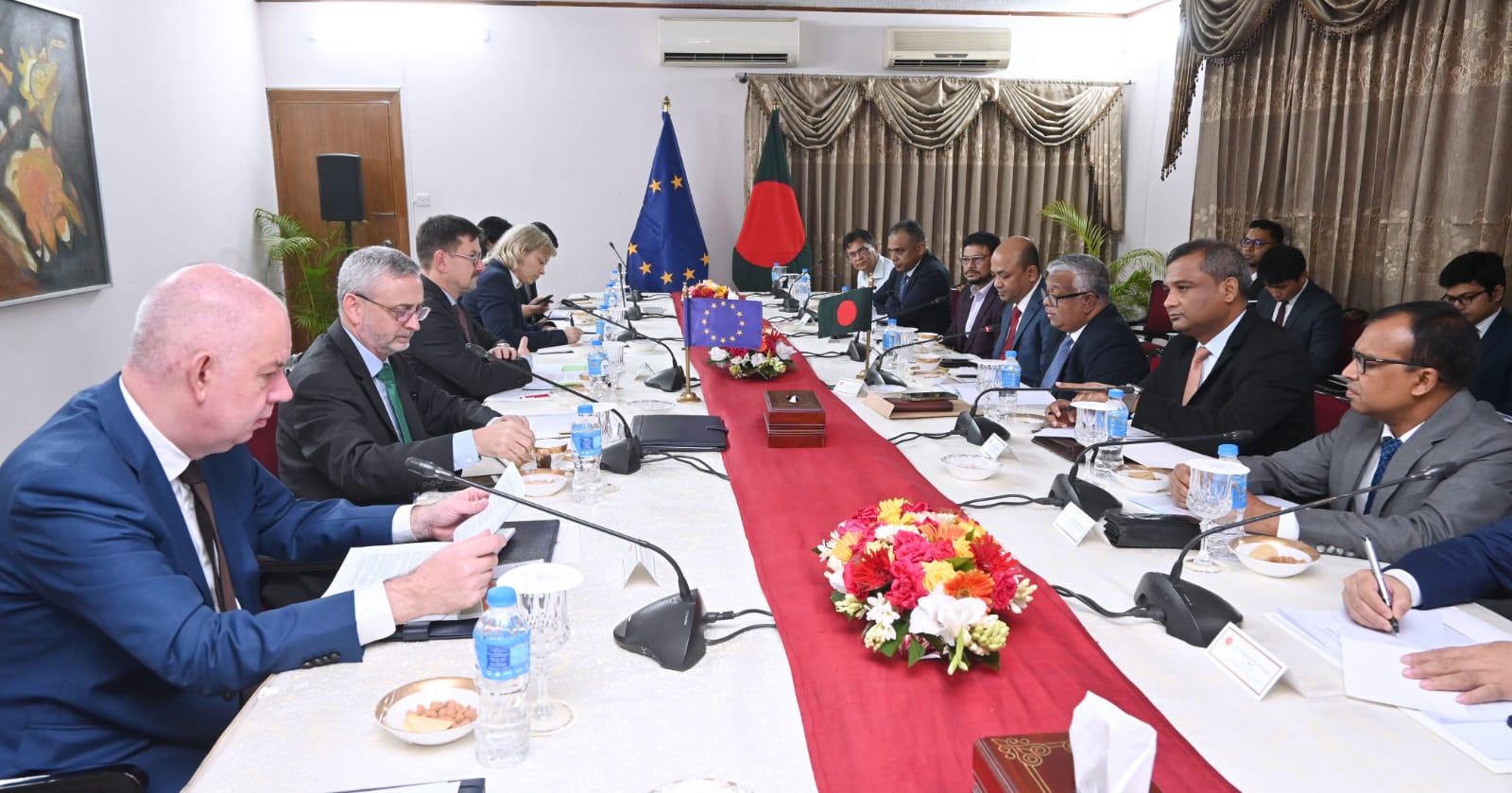
fifth Bangladesh-EU Diplomatic Consultations held in Dhaka after a gap of
nearly five years.
The meeting was
co-chaired by Bangladesh Foreign Secretary Asad Alam Siam and Managing Director
for Asia Pacific of the European External Action Service Erik Kurzweil, according
to a foreign ministry’s press release.
The consultations
reviewed the current state of Bangladesh-EU relations and explored avenues for
further engagement in priority sectors.
Both sides welcomed the
recent initialling of the Bangladesh-EU Partnership and Cooperation Agreement
(PCA), expressing hope that, after completion of internal procedures, it would
provide a structured and comprehensive framework for future cooperation.
The EU also acknowledged
Bangladesh’s successful conduct of the February 2026 parliamentary elections,
referring to the final report of the EU Election Observation Mission.
The two sides also
exchanged views on democratic governance, human rights and the rule of law.
Bangladesh expressed interest
in strengthening cooperation in research and innovation through wider
participation in Horizon Europe and through joint initiatives on knowledge
exchange, technology transfer and capacity building.
Migration and skills
development also featured in the discussions, with Bangladesh outlining
progress in labour reforms and stressing the importance of expanding safe and
regular migration pathways.
The two sides also
discussed stronger cooperation to combat human trafficking and irregular
migration.
On climate change,
Bangladesh reiterated its vulnerabilities and called for enhanced access to
climate finance, technology transfer and support for adaptation and resilience
efforts, including under the EU’s Global Gateway initiative.
The consultations also
covered regional and global developments, including the current Middle East
crisis.
Bangladesh reiterated
the need for stronger and sustained international attention to resolve the
Rohingya crisis.
Both sides reaffirmed
their commitment to multilateralism and a rules-based international order and
appreciated the importance of holding regular consultations to unlock the full
potential of Bangladesh-EU relations.