
Boeing advances quantum internet ambitions with successful space-ready networking test
প্রকাশ: শনিবার । জুন ২০, ২০২৬
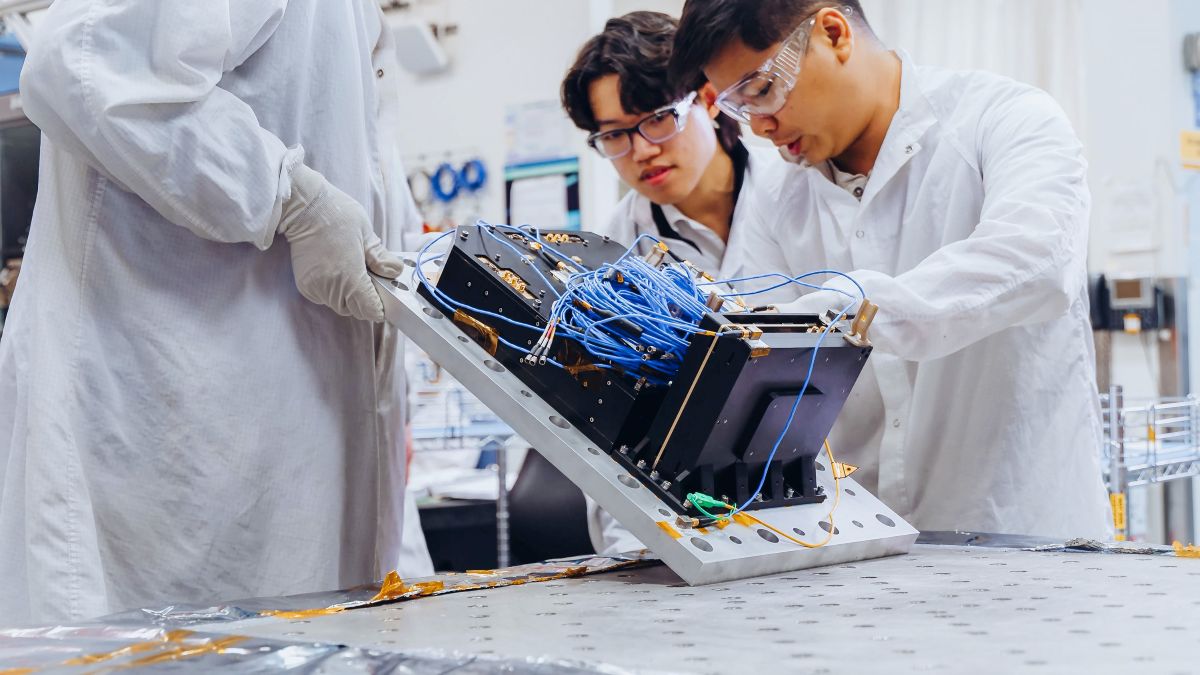
Boeing said on Thursday it had successfully completed ground tests of a space-qualified quantum networking payload, marking a significant step toward demonstrating quantum communications technology in orbit and advancing its long-term goal of building a global quantum internet.
In a statement, the US aerospace giant said its Quantum 4 Space (Q4S) satellite system achieved high-fidelity entanglement swapping during laboratory testing while operating within the size, weight, and power constraints required for space missions.
The company said the tests, conducted on compact hardware designed for use in orbit, also included environmental qualification procedures to verify the payload could withstand launch conditions and the harsh environment of space. Boeing said the Q4S mission remains on schedule for a 2027 launch and a one-year on-orbit demonstration.
Entanglement swapping is a quantum process that allows information links to be extended beyond direct point-to-point connections and is considered a fundamental component in the development of future quantum communication networks.
Boeing said quantum networks could eventually enable highly precise connections between distant sensors, clocks, and computing systems while also supporting future secure communications, navigation systems, and advanced sensing applications across air, land, sea, and space domains.
"Quantum networking has the potential to transform how information is shared, timed, and protected across global systems, but only if it can work outside the lab, under real mission constraints," said Lane Ballard, Boeing's chief technology officer.
"Q4S is about taking an important quantum capability and proving it on mission-ready hardware. That is how breakthrough science becomes useful technology," he said.
Quantum technologies have attracted growing investment from governments and private companies worldwide because of their potential applications in communications, cybersecurity, computing, and defence systems.
However, translating laboratory experiments into operational systems remains a major challenge, particularly in space, where equipment must operate with strict limitations on size, weight, and energy consumption.
Jay Lowell, chief scientist for Boeing's Quantum Systems organisation, said maintaining strong performance under spacecraft constraints had been one of the project's most difficult technical challenges.
"These test results show that we can produce high-fidelity swaps on a payload engineered for space, not just for a controlled lab bench," Lowell said.
Boeing said data collected during the planned one-year mission would be used to evaluate payload performance in orbit and assist in defining future quantum networking architectures. The company said it intends to submit the technical findings from the programme for peer review.
The initiative is part of Boeing's wider investments in next-generation technologies, including quantum communications, sensing, navigation, and computing, as aerospace and defence companies seek to develop new capabilities for use in future civilian and military applications.
Source: PR