
Can Maldives Rewrite the Future of Cox’s Bazar and Kuakata?
প্রকাশ: রবিবার । মে ১৭, ২০২৬
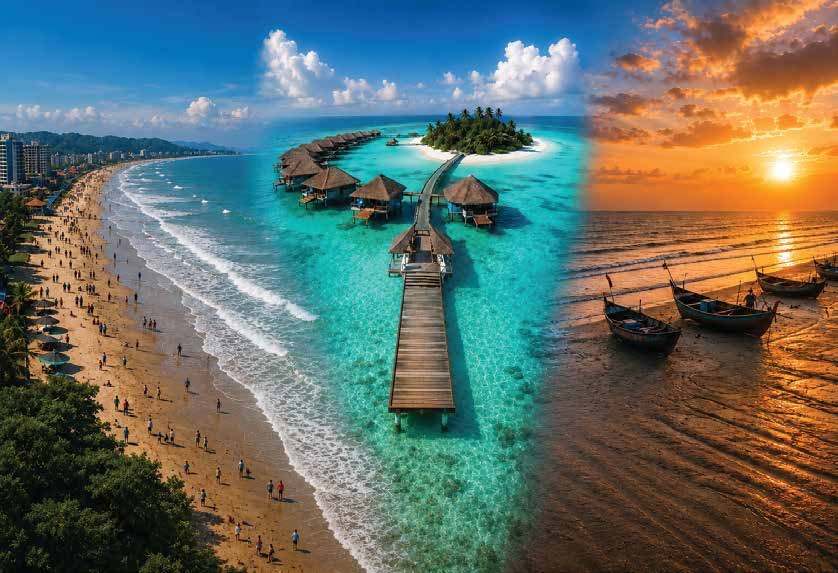
by Muhammad Hassan Pallab
The discussion on whether the Maldives can help reshape Bangladesh’s coastal tourism landscape gained fresh momentum during a recent diplomatic meeting in Dhaka. The Maldives Ambassador to Bangladesh paid a courtesy call on Civil Aviation and Tourism Minister Afroza Khanam at her office, where both sides explored ways to deepen cooperation in the tourism sector. State Minister M. Rashiduzzaman Millat was also present.
During the meeting, both countries expressed interest in signing a Memorandum of Understanding (MoU) aimed at strengthening collaboration in tourism. The proposed framework is expected to support knowledge sharing, tourism infrastructure development, and joint initiatives between Bangladesh and the Maldives.
Against this backdrop, the bigger question now emerging is not just diplomatic—it is structural: can Bangladesh realistically draw lessons from the Maldives model to transform Cox’s Bazar and Kuakata into globally competitive coastal destinations?
Maldives: A Carefully Engineered Tourism Economy
The Maldives is not simply a scenic island destination; it is a tightly engineered tourism system. Its success lies in a controlled development model where individual islands are often designed as single resorts, ensuring exclusivity, environmental balance, and a strong luxury positioning.
Over time, the country has built a globally recognised tourism brand targeting high-spending visitors. The Maldives earns over 60% of its GDP from tourism and welcomes around 1.8 million tourists annually—despite having a small population. Its per-visitor spending remains among the highest globally, driven by premium resort-based tourism.
Bangladesh: Growing Arrivals, But Structural Gaps Persist
Bangladesh, in contrast, is still at an early stage of tourism positioning in the global market. According to Bangladesh Tourism Board data, the country received around 650,000 to 660,000 foreign tourists in 2024, up from 621,000 in 2019.
While this shows gradual recovery and growth, the scale remains modest compared to regional tourism hubs. Tourism’s contribution to GDP is still under 3%, and the sector continues to rely heavily on domestic travel rather than high-value international arrivals.
Cox’s Bazar—the world’s longest natural sea beach—and Kuakata offer strong natural assets, but the development model remains largely mass-market and unstructured. Issues such as limited high-end tourism infrastructure, seasonal overcrowding, and uneven service quality continue to affect the overall visitor experience.
Structural Reasons Behind Bangladesh’s Tourism Lag
Bangladesh’s tourism sector continues to struggle despite its natural potential. Industry observers point out that although the country offers globally significant coastal assets, it has not been able to convert them into strong international positioning. Weak branding, limited high-value tourism infrastructure, and inconsistent service standards remain key constraints.
Compared to regional tourism hubs, Bangladesh still attracts a relatively small number of foreign visitors. Even with gradual improvements in arrivals, it remains far behind competing destinations in South and Southeast Asia. Analysts argue that the absence of structured tourism zoning, underdeveloped hospitality ecosystems, and limited investment in premium tourism products have restricted competitiveness.
Experts also note that tourism development has often been project-based rather than strategic. This has resulted in uneven growth across destinations, with Cox’s Bazar facing pressure from mass tourism while Kuakata remains underdeveloped in terms of international visibility.
The Structural Gap, Not Just a Natural One
The Maldives–Bangladesh comparison is often framed geographically, but the real gap is institutional.
The Maldives implemented strict coastal zoning early, limiting uncontrolled expansion and aligning private investment with a clear luxury tourism strategy. Bangladesh, however, is still balancing rapid tourism growth with planning limitations and infrastructure pressure.
As a result, Bangladesh has yet to fully develop segmented tourism products—such as dedicated luxury coastal zones, eco-tourism clusters, and regulated mass-tourism areas.
What Bangladesh Can Learn—But Not Copy
The current engagement with the Maldives should be viewed as a framework for learning rather than replication. Bangladesh can benefit from coastal zoning practices, environmental safeguards, and structured service standards.
However, copying the Maldives model directly is neither practical nor aligned with Bangladesh’s geography or tourism scale.
A hybrid coastal tourism strategy—balancing mass tourism with designated premium zones—appears more realistic.
The Real Question Ahead
Ultimately, the Maldives will not rewrite the future of Cox’s Bazar and Kuakata. The outcome will depend on Bangladesh’s own policy execution and long-term planning discipline.
The success of any MoU or cooperation framework will be measured not in diplomatic intent, but in whether Bangladesh can translate natural potential into a structured, globally competitive tourism system.
Rafeuzzaman, President of Tour Operators Association of Bangladesh (TOAB), told Aviation Express that Bangladesh already has world-class coastal assets in Cox's Bazar and Kuakata, but sustainable planning and service quality remain critical gaps. “The Maldives offers valuable lessons in destination management, coastal zoning and premium tourism development. Bangladesh should not copy the Maldives, but learn from its discipline to build globally competitive beach destinations in its own identity,” he said.