
Govt takes comprehensive measures for smooth LDC graduation: Finance Minister
প্রকাশ: সোমবার । নভেম্বর ১৬, ২০২৬
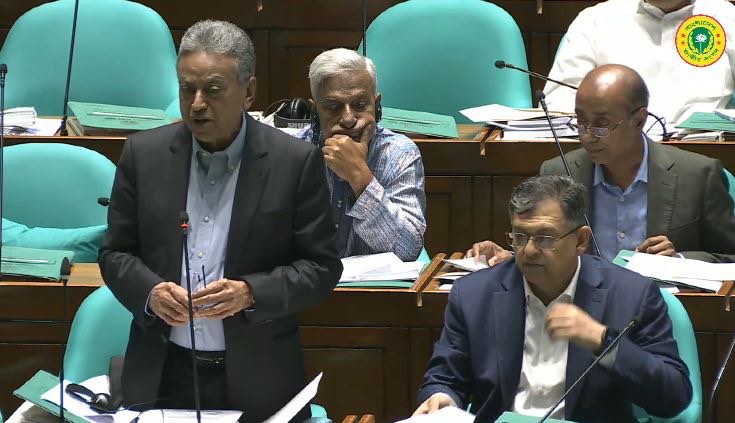
Finance and Planning Minister Amir Khosru Mahmud Chowdhury today said the government has undertaken a comprehensive set of policy measures, including a national roadmap, financial reforms and alternative financing strategies to ensure a smooth and sustainable transition of Bangladesh from the Least Developed Country (LDC) category.
“Through proper implementation of the national roadmap and the revised Smooth Transition Strategy, along with reforms in alternative financing, debt management and the capital market, we will be able to address the potential challenges and ensure a smooth and sustainable LDC graduation,” he said.
The minister said this while responding to a call attention notice on matters of urgent public importance under Rule-71 of the Rules of Procedure raised by independent lawmaker from reserved women’s seat-49 Sultana Jesmen in the Jatiya Sangsad.
The finance minister said the United Nations initially scheduled Bangladesh’s graduation from the LDC category for November 24, 2026, following the completion of a five-year preparatory period.
However, the economic pressures following the COVID-19 pandemic, the Russia-Ukraine war, regional conflicts, the political changes in July 2024 and weaknesses in the financial sector had hampered the country’s reform initiatives and graduation preparations.
Against this backdrop, leading chambers and business associations urged the government to seek an extension of the preparatory period.
The government subsequently requested the UN and UNCTAD to prepare an independent assessment of Bangladesh’s graduation readiness.
The Bangladesh Graduation Readiness Assessment highlighted significant gaps in preparations and the serious disruptions to the country’s readiness process, he said.
Considering the assessment, Bangladesh formally requested the UN Committee for Development Policy (CDP) on February 28, 2026, to extend the preparatory period by another three years, until November 24, 2029.
The UN General Assembly unanimously approved the three-year extension on October 29, 2026. Accordingly, Bangladesh will graduate from the LDC category on November 24, 2029, the minister said.
Describing LDC graduation as a matter of pride, he said the transition would also bring several challenges as Bangladesh would gradually lose special international support measures (ISMs) currently available for LDCs.
To address the challenges, the government has prepared a National Roadmap for Smooth, Sustainable and Irreversible LDC Graduation (2026-2029).
The roadmap identifies five transformational pillars: macroeconomic stability; trade, market access, productivity and industrialisation; human resource development and skills; and good governance and partnership, alongside other key areas of economic transformation.
It identifies 21 major action areas, with designated lead and co-lead agencies and specific implementation timelines. It also includes 15 high-impact action areas for the private sector, focusing on technology upgrading, environmental, social and governance (ESG) standards, labour compliance, skills development, product and market diversification, green investment and public-private collaboration.
The government is also revising the previously formulated Smooth Transition Strategy in light of the changed circumstances.
For effective implementation and coordination, the government has formed a National Graduation Monitoring and Coordination Committee, headed by the Finance Minister.
The committee will review implementation progress, coordinate activities, address bottlenecks and provide policy guidance. It will meet at least once a month, and two meetings have already taken place.
A public-private joint task force, led by the Secretary of the Economic Relations Division (ERD), is also working to facilitate business, trade and investment with participation from government and private-sector representatives, he said.
On development financing, the minister said Bangladesh would gradually face reduced access to concessional financing and higher borrowing costs after graduation.
Against this backdrop, the government is restructuring the country’s public financing architecture to diversify funding sources and maintain development financing in the post-graduation period. He said the government had set the budget deficit at 3.6 percent of GDP in the 2026-27 fiscal year and aimed to maintain fiscal discipline through higher revenue mobilisation and prudent debt management.
The government is updating its Medium-Term Debt Management Strategy and conducting regular Debt Sustainability Analyses to bring the country’s debt risk rating from moderate to low.
It also plans to gradually reduce government borrowing from the banking system and combine domestic revenue, concessional foreign financing and market-based instruments to meet budgetary requirements.
For the first time, the government is examining the possibility of issuing sovereign bonds to diversify external financing sources. Dollar bonds, Panda bonds and Samurai bonds are among the instruments under consideration.
The minister said the government also wanted to transform the capital market into a major source of long-term financing to reduce dependence on bank borrowing.
The initiatives include expanding the corporate bond market, introducing municipal bonds for local government and urban infrastructure development, and increasing the use of bonds, Sukuk and infrastructure funds for long-term public and private-sector projects.
The government is also encouraging greater participation by institutional investors, including pension funds, insurance companies, asset management companies and mutual funds.
Besides, an initiative is underway to establish a Bangladesh-dedicated equity fund in Hong Kong to attract international equity investment without creating direct debt obligations, he said.
Responding to a supplementary question from Sultana Jesmen, the minister acknowledged the importance of modernising the education system, expanding research facilities and developing skills to meet the challenges of demographic transition and LDC graduation.
He said the government has placed greater emphasis on skills development and capacity building alongside conventional education.
“The government has allocated significantly more funds to the education sector than in previous years, and this trend will continue,” he said.
He added that the government’s election manifesto had pledged to increase investment in education to 5 percent of GDP, and the government was committed to moving towards that target.
The minister said skill-development would play an important role in preparing the country’s workforce for the post-graduation economic environment.