
Gulf airlines get back to business as flights near pre-war levels
প্রকাশ: শুক্রবার । জুন ১৯, ২০২৬
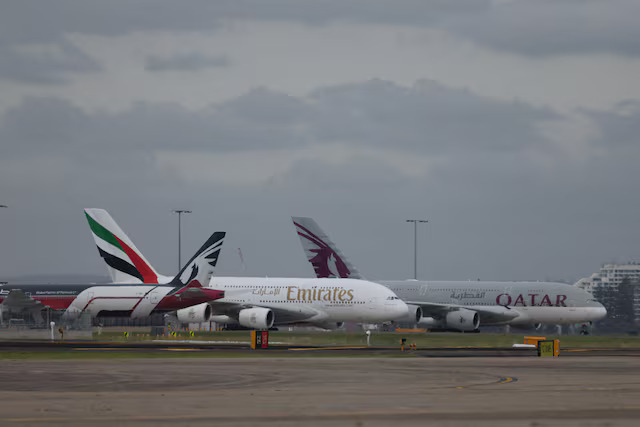
The Middle East is home to some of the world's biggest carriers, whose networks have been upended by the Iran conflict, with Iranian missile and drone attacks at times shutting airports in recent months and redrawing traffic routes across the Gulf.
Flightradar24.com data shows that the overall number of flights by major Gulf airlines has now returned to some 82% of the level on February 27, the day before the war started. Gulf Air and Kuwait Airways have topped 100% of that level in recent days.
Emirates, Qatar Airways and Etihad - the biggest three - are above or near 90% of their pre-war level. Etihad and Qatar Airways were as low as 40-50% just a month ago. Emirates, which has spent big to keep flights going, has been higher for longer.
After the U.S. and Iran signed an interim agreement on Wednesday to end the near four-month conflict, and are expected to discuss implementing the ceasefire deal on Friday, the outlook for Gulf airlines is potentially looking much brighter.
The end of hostilities would lead to a reopening of the region's airspace allowing regional carriers to completely resume their operations, said James Halstead, managing partner at Aviation Strategy.
"If it gets back to normal, I just see them acting as normal, coming back in full force," Halstead said.
SAFETY CONCERNS
Drone attacks during the Iran conflict have repeatedly forced Gulf-bound flights to divert, raising safety concerns for passengers and crew and limiting routes to a handful of safe aviation corridors.
European and Asian carriers have largely halted flights to the region, with many warnings still in place. Australia this week though relaxed its travel advice for several Middle Eastern countries, a boost for the transit hub.
The European Union Aviation Safety Agency (EASA) has kept its warning in place against flying to the region due to risks associated with the conflict.
EASA told Reuters it will take into consideration the latest developments when reassessing its conflict-zone warning for the region, valid until June 24. However, it said it was still "too early to determine whether the observed de-escalation will result in a sustained reduction of risks to civil aviation".
FALLOUT REACHES WELL BEYOND GULF
The oil-rich Gulf region has been making a major effort in recent years to boost its role as a global transport hub and tourism destination, with huge investment in hotels, airports and events. Re-opening the skies fully should boost Gulf economies.
Emirates CEO Tim Clark told Reuters last week that the carrier would focus on reassuring travellers about safety and reliability. The Dubai-based carrier is at 86% of its pre-conflict flight volume, Flightradar24.com data shows.
Etihad is offering visitors to Abu Dhabi complimentary medical travel insurance from July through December.
Gulf Air's and Etihad's volumes were at 93% of their February levels, while Kuwait Airways and Qatar Airways had reached 86% and 87%, respectively. Flight volumes at Air Arabia and Flydubai were lower at 75% and 57% of their pre-war levels.
The fallout from the conflict has reached well beyond the Gulf. Soaring jet fuel prices - now coming down - have squeezed carriers without oil hedges, schedules have been disrupted across Europe and Asia, and airlines have warehoused jets and run lengthy "flights to nowhere" to reposition aircraft.
This month, the International Air Transport Association - which represents more than 370 airlines accounting for about 85% of global air traffic - nearly halved its previous 2026 profit forecast for the industry due to the Iran war. It now expects a combined net profit of $23 billion, well below a previous projection of about $41 billion and down from $45 billion in 2025.
Source: Reuters