
The World's Best Airlines of 2027
প্রকাশ: বুধবার । নভেম্বর ১৮, ২০২৬
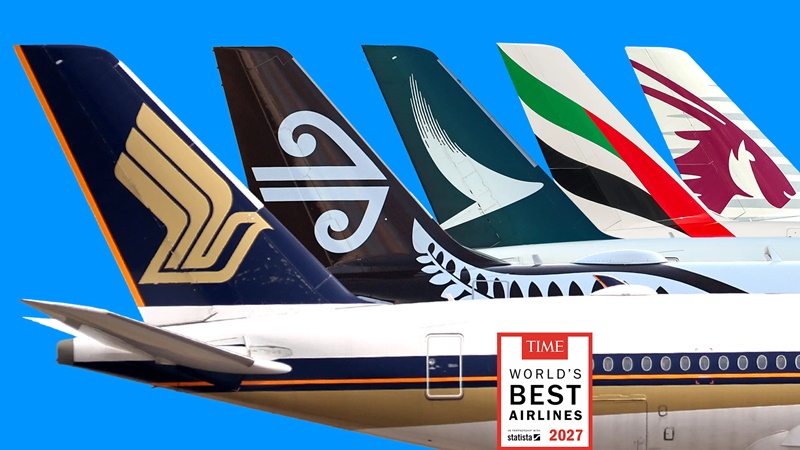
Air travel has become a hot button issue over the past decade, as fuel prices fluctuate and airlines attempt to cut costs. This year, TIME partnered with Statista to highlight airlines across the globe that excel in passenger experience and operational performance based on surveys conducted in the past three years and independent flight data analysis provided by OAG. The list also breaks out the “Most Reliable Airlines,” “Best Airlines for Business Travel,” and “Best Airlines for Long-Haul Flights,” according to survey respondents.
While the overall trend points to a post-pandemic rebound in sales, volatility remains in the industry as operators navigate the new normal amidst supply chain challenges, rising fuel costs from geopolitical instability, changing travel patterns, and aircraft backlogs. The IATA projects that passenger traffic will continue to grow year over year, with the industry revenue reaching over $1 trillion. However, although growth is still expected this year, in June 2026, IATA changed their yearly profit forecast for the industry to $23 billion on total revenues of $1.17 trillion, with a net margin of just 2%. This is about half the figure predicted prior to the war in Iran.
“[Airlines] are running on real thin margins. Profit per passenger IATA gives is about $4.50,” says Seçkin Özkul, assistant professor and director of the University of South Florida Supply Chain Innovation Lab. “The revenues are in the couple of hundreds, but then they are paying a lot of things out.”
According to IATA’s June report, the main challenge for airlines is that costs are rising faster than revenues, especially the fuel bill, which is set to reach $351 million this year and account for 31.4% of total operating costs. “Industry revenues are projected to increase by around 9.5% in 2026, supported by higher passenger and cargo yields. Yet expenses are expected to grow by 13.1%, more than offsetting the revenue gains,” the report stated.
The other cost to consider is replacing aging fleets. “Older planes cost more because of higher amounts of maintenance, and also they burn more fuel,” Özkul says.
To balance the numbers, more airlines are trying to increase their ancillary revenue which includes add-ons to base tickets like seat selection, luggage, meals, lounge access and more. In 2025, airlines made close to $160 billion in ancillary revenue, which comprised nearly 16% of their overall revenue. The proportion has been growing for the last decade—it was only around 9% in 2016. Additionally, the bigger airlines in the U.S. earn billions from their loyalty programs.
Airlines also try to fill planes up as much as possible, because fuller planes means that fixed costs are distributed over more customers. “That's why they sometimes run into issues that they oversell,” Özkul says, “because they have amazing industrial engineers who calculate the possibilities of people missing the planes.”
To better cater to modern flyers, small airlines often offer a low-cost base experience, and charge for add-ons. One of the best to do it is Ryanair, known for its memes and sassy online presence, but also for operational efficiency. They are ranked no. 1 on the Most Reliable Airlines sublist.
“Because they are a low cost airline, their margins are possibly even thinner than what we're talking about,” Özkul says “They have to optimize to the minute of their flights, and they have to keep those operations in such a tight schedule to deliver on the reliability.”
On the other hand, bigger airlines have responded by offering basic economy to compete on price, and splashing out more to attract premium customers who are willing to shell out for comfort and convenience. According to The Associated Press, “carriers increasingly build their businesses around selling first-class, business-class and premium-economy seats.” Additionally, a 2026 report by McKinsey found that on popular transatlantic routes, “a business-class cabin might now contribute nearly as much revenue as an economy cabin while using far less space on the plane and delivering higher margins.”
Emirates, ranked no. 1 on the overall list of World’s Best Airlines as well as the sublist of Best Airlines for Business Travel, has built a reputation for being one of the best luxury flying experiences, and it continues to expand its premium economy offering across its routes. It's benefitting from a burgeoning tourism industry in Dubai, where it’s headquartered, which was becoming a tourism hotspot and has recently started to show signs of recovery from the dip caused by the war in Iran. It is also working with tourism partners in multiple countries across the Indian Ocean, Europe, Southeast Asia and the UAE to create special travel packages for its customers.
See the full list, and sublists, of the World’s Best Airlines of 2027 below:
TIME World's Best Airlines 2027
Emirates topped the list of the world’s 25 best airlines with a score of 94.29. Qatar Airways ranked second with 94.16 points, followed by Air New Zealand in third place with 93.47 points. Singapore Airlines secured fourth place with 93.32 points, while Cathay Pacific Airways ranked fifth with 92.63 points.
Delta Air Lines of the United States ranked sixth with 92.17 points, followed by South African Airways in seventh place with 92.16 points. China Southern Airlines ranked eighth with 92.03 points, Air China ninth with 91.99 points, and American Airlines tenth with 91.89 points.
Alaska Airlines ranked 11th with 91.86 points, followed by FlySafair in 12th place with 91.75 points, Southwest Airlines in 13th with 91.68 points, Turkish Airlines in 14th with 91.60 points, and Finnair in 15th with 91.50 points.
LOT Polish Airlines secured 16th place with 91.41 points. British Airways ranked 17th, Shandong Airlines 18th, and JetBlue 19th, each scoring 91.36 points. Etihad Airways took 20th place with 91.23 points.
The remaining five airlines in the top 25 were China Eastern Airlines in 21st place with 91.22 points, United Airlines in 22nd with 91.08 points, Philippine Airlines in 23rd with 91.05 points, Iberia in 24th with 90.94 points, and Shenzhen Airlines in 25th place with 90.89 points.
Click here to view the full list.
Source: TIME Magazine