
Tourism Failure: Couple of Coconut Trees, Few Swings — Billion-Dollar Tourism Missed
প্রকাশ: শুক্রবার । এপ্রিল ১৭, ২০২৬
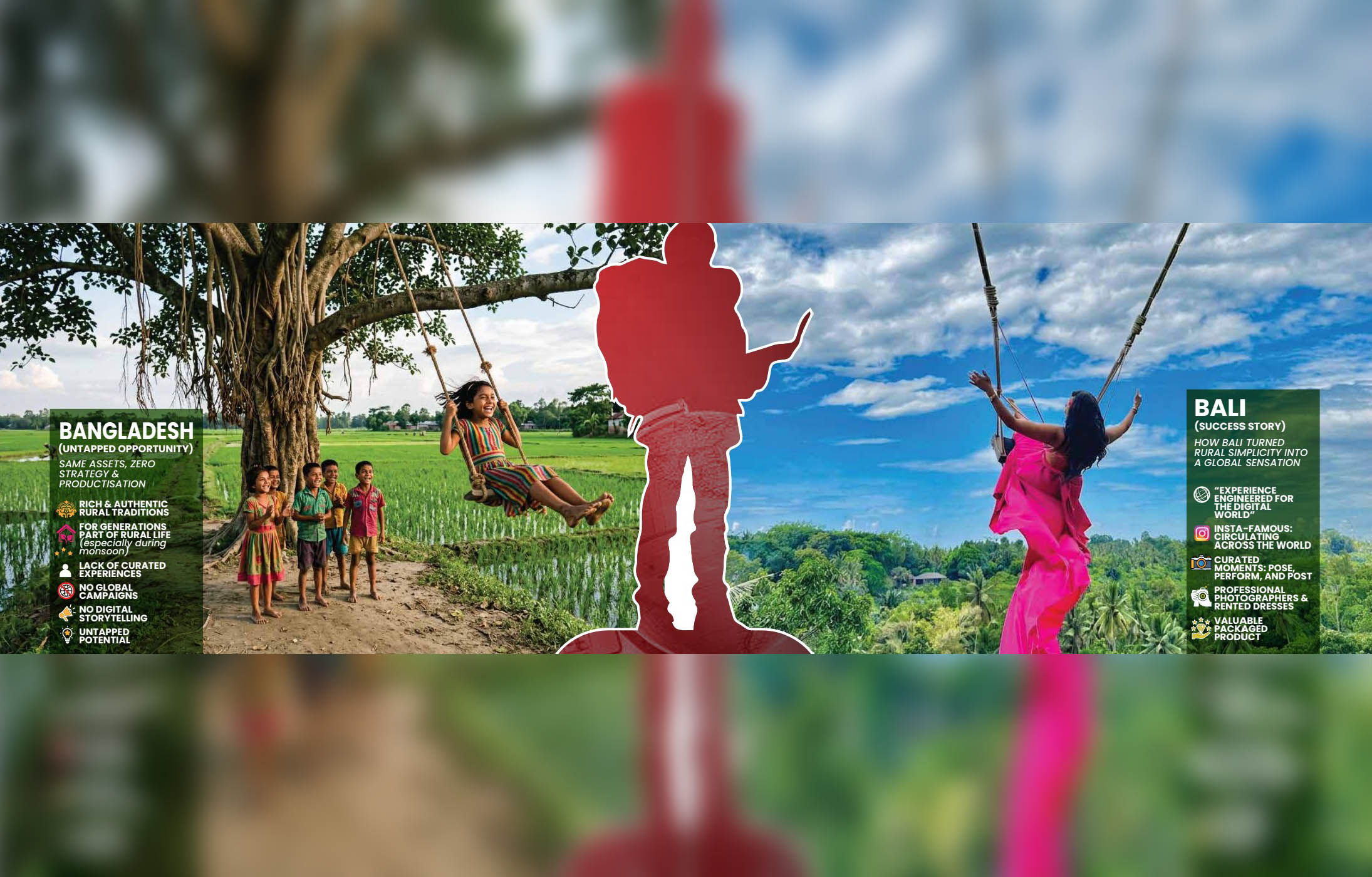
—Tanzim Anwar back from Bali
A few coconut trees, some swings and endless paddy fields—Bali turned this simple rural setup into a global tourism sensation. Bangladesh has the same, yet continues to miss out on a billion-dollar opportunity.
I recently stood on a swing in Bali—strapped between two coconut trees, floating over lush green rice terraces. Below me, tourists queued for their turn. Around me, cameras clicked non-stop. And within seconds, those images were on Instagram—circulating across the world.
That’s when the question hit hard: Why not
Bangladesh? Because what Bali has… Bangladesh already does.
For generations, swings tied to coconut trees
have been part of rural life in Bangladesh—especially during monsoon festivals.
The same paddy fields. The same village aesthetics. The same golden sunsets.
But here’s the difference. Bali sells it.
Bangladesh never even thought of it
A Swing That Built a Global Brand
The now-famous Bali Swing started in 2017. Nothing extraordinary—just a swing over a valley. But what followed was extraordinary.
They packaged it. Styled it. Marketed it. And most importantly—they made it go viral.
Today, Bali Swing is not just a ride. It’s a global tourism icon.
Visitors don’t just swing—they pose, perform, and post. Professional photographers guide them. Flowing dresses are rented. Every angle is curated.
It’s not tourism. It’s experience engineered for the digital world. And the world is buying it.
Keisha Buckland, an American tourist, who usually celebrates her birthday on the beach, chose a different experience this year. In Bali, she opted for the iconic swing, soaring above lush greenery with a sense of thrill and freedom.
“This time, I didn’t just enjoy the moment, I
turned it into something more. It was a new kind of fun, a different way to
celebrate, and I truly felt like I was expanding my horizons,” Buckland said,
adding, “It was exciting, bold, and completely unforgettable.”
Bangladesh: Same Assets, Zero Strategy
Back home, Bangladesh sits on the same natural canvas.
Coconut trees? Everywhere. Paddy fields? Endless. Rural traditions? Rich and authentic.
Yet none of it is turned into a product. No curated experiences.
No global campaigns. No digital storytelling.
Just untapped potential. But Why?
Tour Operators Association of Bangladesh (TOAB) President Rafeuzzaman said the failure is not about resources—but mindset.
“We always think tourism needs big infrastructure. Bali proved otherwise. They took something simple and made it global. We have similar assets, but we never packaged them,” he said.
The TOAB chief criticized the government as the Bangladesh Tourism Board, which main responsibility is to making tourism products and promote it, is lack of tourism professionals.
“Our Tourism, board is heavily depends on
beaurucrate to run the organizations. We need tourism mind in our NTO to think
out of the box .. to plan how we can utilize our untapped potentials in front
of global tourists” he
said.
The Digital Failure
If Bali built the swing, social media made it explode.
From influencers to celebrities, everyone wanted “that swing shot.”
It became a bucket-list experience. Bangladesh never entered that game.
PATA Bangladesh Chapter Secretary General Taufiq Rahman pointed straight at the problem.
“We are missing in digital tourism marketing. Bali didn’t just create a product—they created a global image. Bangladesh has not invested in that space,” he said.
“No digital campaign means no global
visibility,” he added.
Tradition vs Tourism Product
In Bangladesh, a swing is just a swing. In Bali, it’s an experience.
Taslim Amin Shovon, chief executive officer of InnoGlobe Travel and Tours said the difference is innovation.
“We have everything—nature, culture, tradition. But we never thought of converting them into tourism products. Bali did. That’s why tourists go there,” he said.
Shovon, who is also TOAB Director (Trade and Fair), emphasized that modern tourists want more than sightseeing.
“They want something they can feel, share, and
remember. That’s where Bangladesh is falling behind,” he added.
A Bigger Problem: No Vision
The swing story is just one example of a deeper issue.
Bangladesh has:
- Cox’s Bazar – the world’s longest sea beach
- Sundarbans – a UNESCO World Heritage site
- Hills, rivers, culture, cuisine
Yet international tourist numbers remain modest
Why?
Because tourism here is still treated as infrastructure, not experience.
There is no strong branding.
No consistent global campaign.
No viral storytelling.
What Bangladesh Must Learn From Bali
The lesson is brutally simple:
You don’t need mega projects to attract tourists.
You need ideas—and how you sell them.
A swing in Bali became a global symbol.
A swing in Bangladesh remains a forgotten tradition.
With proper planning, Bangladesh could create:
- Village-based swing parks
- Instagram-ready rural experiences
- Community-driven eco-tourism
- Youth-focused digital campaigns
The ingredients are already here.
What’s missing is execution.
The Bottom Line
Bali didn’t invent coconut trees.
It didn’t invent swings.
It didn’t invent rice fields.
It just understood their value—and sold it to the world.
Bangladesh is still waiting to do the same.
Until then, a couple of coconut trees and a few
swings will remain just that—
Not a tourism product.
But a billion-dollar opportunity missed.