
“We Need Policy Support—Not Financial Incentives”
প্রকাশ: সোমবার । ফেব্রুয়ারি ০২, ২০২৬
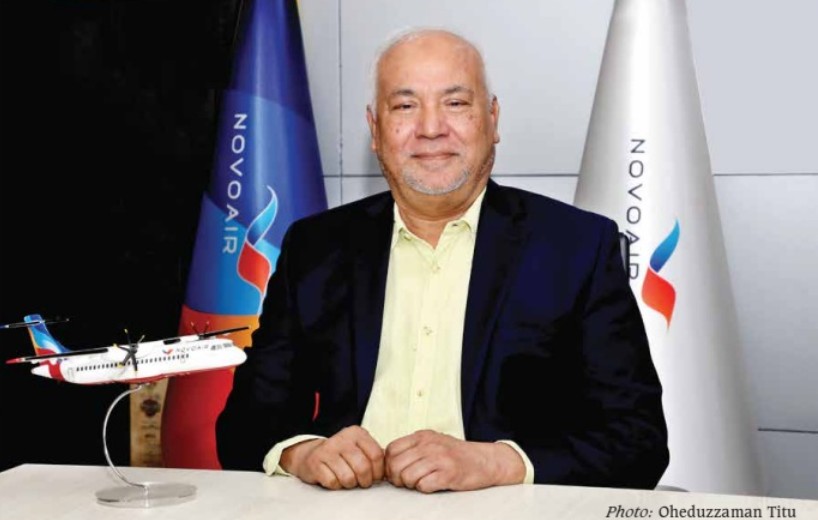
For nearly fifteen years, NOVOAIR has navigated Bangladesh’s turbulent and stormy private airline landscape, surviving where many others failed. In wide-ranging interview with Aviation Express, Managing Director Mofizur Rahman explains why global aircraft shortages, regulatory rigidity and policy contradictions—not market demand—are now the defining constraints on local airlines, and why survival depends on policy reform, not subsidies.
As NOVOAIR enters its 14th year of operations, what is your long-term vision?
Our vision has not changed what we have articulated from the onset. From the very beginning, NOVOAIR’s long-term plan included international expansion, particularly into Southeast Asia and the Middle East. Singapore, Muscat and similar regional hubs were always part of our roadmap.
What changed was timing. When we finally moved decisively toward expansion in mid-2023, we ran straight into the worst global aircraft supply crisis in modern aviation. What should have been our growth phase suddenly became a struggle for survival.
How severe is the global aircraft shortage?
The shortage is unprecedented and driven by three interconnected shocks.
First, the post-Covid impact. Aircraft and engine manufacturers laid off skilled workers during the pandemic. When demand returned sharply, they could not scale up production. Engine overhauls and component manufacturing slowed dramatically, jobs that once took one year now take three. The other two factors are UKRAINE war effect which severely impacted on aviation supply chain including sharp increase in fuel price. Supply chain disruption and Boeing industry B-737 Max 9 &10 certification delay of over five years impacted heavily in causing an acute shortage of mid haul aircraft availability.
Given the current crisis, does NOVOAIR foresee any immediate breakthrough in aircraft sourcing?
There is a measure of cautious optimism. We are currently in the process of securing two Boeing 737-800 aircraft, which would enable us to commence international operations. The choice of Boeing over Airbus is driven purely by aircraft availability. Airbus aircraft are extremely scarce in the current market, with delivery timelines extending far into the future. By contrast, Boeing 737-800s are relatively more accessible in the secondary market. For an airline like ours, timing is critical, we cannot afford prolonged delays while viable market opportunities pass us by.
How has the reduction of the aircraft age limit from 20 to 15 years affected local carriers?
It has had a massive impact—far greater than policymakers appear to realise.
Civil Aviation Authority of Bangladesh (CAAB) reduced the age limit from 20 years to 15 years without meaningful consultation, despite knowing that sourcing aircraft under 15 years is nearly impossible in the current market. This decision effectively shut the door on expansion for both private airlines and even the national carrier.
The Boeing 737-800 series stopped production in 2019. Many aircraft that are safe, well-maintained and flying elsewhere no longer qualify for import into Bangladesh. NOVOAIR has operated safely for nearly 14 years with aircraft imported with 20 years of age and operating beyond without any safety issue. Aligning our policy with regional norms—such as Maldives does have no age restriction at all, therefore18 years in Pakistan and India’s 20-year limit, would be far more realistic. Safety is about maintenance, oversight and culture, not just calendar age.
In hindsight, was focusing on domestic expansion before going international a strategic mistake?
Very relactantly I may agree that it is now considered as a strategic mistake which is driven by world phenomenon like Covid 19 and Ukraine war. Our business philosophy was to have an airline of passenger choice in domestic sector which we believe that we could deliver with safety, passengers satisfaction and goodwill. We had a limited aspiration for mass scale expansion to international forefront.
Between 2016 and 2019, we had a clear choice: expand internationally or strengthen domestic operations. Domestic demand was growing rapidly, and we were not even meeting full demand at that time, so prioritising domestic growth made sense.
Then Covid arrived and changed everything. In hindsight, with a smaller fleet with earlier international exposure might have been beneficial. But decisions must be judged in their historical context. Today, we face two pressures simultaneously—international expansion and replacing our ATR fleet—so we are sequencing our strategy: international first, domestic fleet renewal later. By the way, there is a general notion in our country that incur loss in domestic sector and subsidize through international’s profit. I am quite against that notion.
Which international routes does NOVOAIR consider commercially realistic?
We do not experiment. We go where demand already exists. In Southeast Asia, we are looking at Bangkok, Kuala Lumpur and Singapore. In the Middle East, Dubai, Sharjah and Muscat. Our aim is to serve these six destinations within the first four to six monthswith two narrow body aircraft. After evaluating performance, we will decide whether to induct a third aircraft. We hope to reach a consolidated position by mid of the year.
What is the single biggest barrier to the growth of local airlines in Bangladesh?
A: Policy—without question, then a very uneven field of competition with national carrier, Biman. Which receives state subsidy and patronization in many forms and formats.
At the state, government and regulatory levels, policies are not business-friendly. Expertise exists to contribute in policymaking, but it is rarely utilised. Interest-group influence leads to opaque and inconsistent decision-making. We submitted a comprehensive list of observations on civil aviation regulations, yet none were implemented.
There is also a structural conflict: civil aviation authority acts as both regulator and service provider. Operators are often forced into overpriced services. Hangar rental expense, for example, which was taka 2 lac per month now stands at Tk40 lac per month, which is unsustainable. Even approved reforms, like extending AOC audit intervals, remain unimplemented due to vested interests.
Should aviation receive incentives, and can Bangladesh realistically become an aviation hub?
I do not support financial incentives. Less than one percent of Bangladeshis travel by air, and government funds should priorities health and education and other essential public sector rather incentivizing airlines whose clientless are affluent.
What we need is policy support, not financial incentive —fair fuel pricing, reasonable charges and the removal of multi-layer tax structure. Fuel pricing reform through BERC hearings is a positive step, but fuel taxes remain high and syndicate influence persists. Undue imposition of tax on spare imports must stop.
As for becoming an aviation hub—airport infrastructure alone does not create one. Dubai, Doha and Singapore became hubs through integrated policy, fuel pricing, tax structures and human-resource development. With some of the world’s highest fuel prices and travel taxes, Bangladesh cannot realistically be a hub today. At best, we can become a strong South Asian aviation player, if policies allow airlines to survive.
How do you view the government’s decision to reduce airlines’ surcharge rates from 72 percent to 14.25 percent?
This is a timely and much-needed decision. For years, the extremely high 72 percent annual surcharge acted more as a punitive penalty than a regulatory tool, pushing airlines deeper into debt and threatening their survival. Reducing it to 14.25 percent not only eases financial stress on local carriers but also brings Bangladesh closer to regional benchmarks. Most importantly, it acknowledges that the bulk of airlines’ outstanding dues stemmed from accumulated surcharges rather than core operational costs. This move can help stabilise the industry, protect local operators, and create a healthier, more sustainable aviation ecosystem—though consistent implementation and broader policy reforms will be crucial for lasting impact.
Final Word
If local airlines cannot grow, foreign carriers will dominate indefinitely.
We do not want handouts. We want fair rules.