7 airports in limbo as funding bottlenecks persist
CAAB plans to reactivate seven defunct airports including Bogra, Lalmonirhat and Shamshernagar, but projects face land acquisition hurdles and budget constraints
 Desk Report
| Published: Saturday, March 28, 2026
Desk Report
| Published: Saturday, March 28, 2026
Collage: Aviation Express
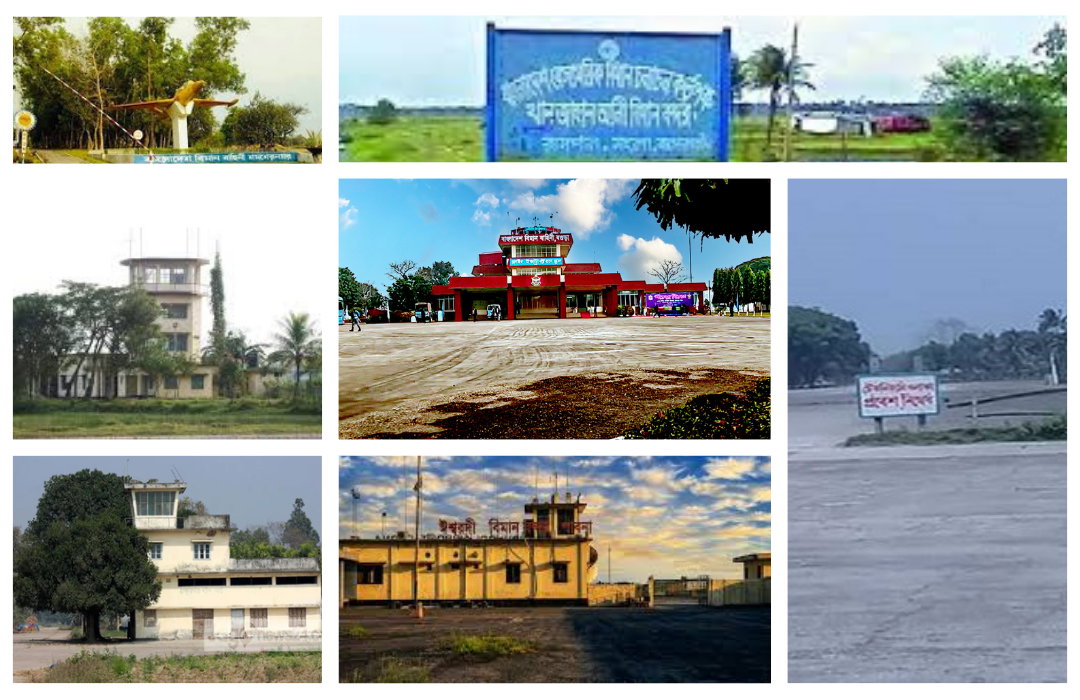
Civil Aviation Authority of Bangladesh has initiated plans to reactivate seven abandoned airports across the country, aiming to boost tourism economy, reduce pressure on road and rail networks, and potentially reshape South Asia's geopolitical dynamics.
Seven abandoned airports are Bogra, Lalmonirhat, Shamshernagar in Moulvibazar, Ishwardi, Thakurgaon, Cumilla and Bagerhat. Bogra airport is slated to become operational first, followed by Lalmonirhat and Shamshernagar.
Bogra: First to Launch
Interim government announced flights would commence from Bogra in July 2025. However, reality tells different story. While TK 10 crore allocation enabled runway, taxiway and terminal repairs, airport lacks modern passenger terminal, control tower, fire and rescue facilities, and essential customs-immigration infrastructure.
Three-phase implementation plan requires approximately TK 1,200 crore, but project has not received final approval. Finance Ministry clearance remains pending, stalling visible progress. First phase needs roughly 100 acres for extending runway to 6,000 feet, costing Tk 25 crore. Subsequent expansion to 10,000 feet requires additional 300 acres.
Local business representatives and civil society have demanded rapid airport activation. “Due to communication gaps, many business opportunities cannot be realized in Bogra. Airport would benefit both businesspeople and tourists”, they told media.
Deputy Commissioner (DC) Md. Toufiqur Rahman provided routine assurances. Local Government, Rural Development and Cooperatives State Minister Mir Shah Alam recently visited Bogra, promising swift action.
“We formed a large committee. After receiving their report, we will inform the ministry about available facilities so Bogra district can access everything. Our activities are ongoing regarding airport implementation”, state minister said.
Bogra airport’s history dates to 1995 land acquisition. Runway, office and residential quarters construction completed in 2000. Airport was transferred to Air Force in 2005, which established a flying instructor school.
Lalmonirhat: Strategic Importance
4-member technical expert team recently conducted on-site inspection of Lalmonirhat and Shamshernagar airports. Built by British in 1931, Lalmonirhat features 4-kilometer runway and ranks as South Asia's second-largest airport by area. Infrastructure includes vast tarmac, hangars and taxiways.
Airport was last used during Second World War, serving as crucial communication hub for Bangladesh's northern region, India's Seven Sisters, Nepal and Bhutan. Despite substantial infrastructure, minor renovations could make it operational again.
Former CAAB Chairman Air Vice Marshal Mohammad Manzur Khovid Bhuiya told media on April 27 last year, “Abandoned airports will be reactivated gradually. Whichever completes infrastructure construction, renovation and auxiliary preparations first will be activated first. Bogra airport is launching first, but commercial operations may take one to one-and-a-half years”.
CAAB will sign agreement with Air Force for Lalmonirhat activation. Commercial launch requires renovations including 10,000-feet runway work.
Experts suggest India might object to Lalmonirhat activation due to proximity to Chicken’s Neck corridor. Previous government perhaps avoided initiating airport launch for this reason. Current government's initiative means India cannot object comfortably. Moreover, Bangladesh will advance in geopolitics, they noted.
Shamshernagar: Regional Hub Potential
Shamshernagar airport in Moulvibazar’s Kamalganj, another Second World War-era facility, has languished in neglect. Air Force opened a unit there in 1975, establishing training school. Training aircraft and helicopters continue using facility under Air Force supervision.
Aviation expert and former Biman Bangladesh Airlines Board member Kazi Wahidul Alam considers Shamshernagar highly important. Nepal and Bhutan have submitted proposals for usage.
“If activated, this airport could develop as regional hub for business-trade expansion with four neighboring countries: China, India, Nepal and Bhutan”, he said.
Activation would ease communication for expatriates and tourists significantly.
Thakurgaon: 46-Year Wait
Thakurgaon airport, built in 1940 on 550 acres in Shibganj area, suffered heavy damage during 1965 India-Pakistan war from Indian Air Force attacks. Renovated in 1977 post-independence, commercial flights operated briefly but ceased in 1980 due to passenger shortage and losses.
After nearly 46 years of waiting, airport made it onto interim government's activation list. Feasibility study estimates TK 987 cr. 10 lakh needed for full activation, requiring minimum four years implementation. Current runway length approximately 6 thousand feet fails to meet International Civil Aviation Organization standards for commercial operations.
Airport currently has 1,159 acres, with large portions used by Army and Air Force for training and projects. Full commercial airport development requires additional 856 acres acquisition.
Modern navigation systems, passenger terminal building, cargo terminal, fire station, control tower, electricity and water supply systems, residential buildings and connecting roads need construction.
Proposed plan includes annual handling capacity of 15 lakh passengers. While initially focusing on domestic routes, future possibilities include regional and international routes, particularly connecting India's northeast, Nepal and Bhutan.
Authorities acknowledge internal funds cannot implement such massive projects. Government budget support, development partner financing or foreign loans require consideration.
Ishwardi: Mega Project Gateway
Ishwardi airport in Pabna plans to resume operations by 2030, serving Rooppur Nuclear Power Plant located just 13 kilometers away. Over 10,000 Russian nationals currently reside in area for mega project. District hosts five important government research institutions and vast agricultural markets across Padma char.
Despite enormous potential, road communication remains time-consuming and problematic, discouraging new investment. Government prioritizes Ishwardi as third airport after Bogra and Thakurgaon.
Built during Second World War, Biman Bangladesh Airlines began regular Dhaka flights in 1989. Operations started and stopped several times due to various crises. United Airlines last operated commercial flights from Ishwardi in 2013, which ceased after roughly one year. Airport has remained dormant for approximately one decade since.
Initially 436.65 acres were acquired, but current jurisdiction reduced to 145.91 acres. Existing 4,700-feet runway, terminal building, VIP lounge, passenger waiting area and officers' residential area have become unusable due to long neglect.
Current runway requires extension to 6,000 feet for commercial flights. New terminal building, modern fire services and adequate manpower recruitment remain necessary. If fully operational, communication between Pabna, Natore, Kushtia regions and Dhaka will become extremely easy and faster.
Bagerhat: Decades of Stagnation
Khan Jahan Ali Airport project in Bagerhat has remained unfinished for over two decades, highlighting significant infrastructure development failure. Construction efforts have lingered for 30 years without reaching completion, leaving critical transportation hub in perpetual limbo. Long-standing uncertainty surrounds project completion, leaving Khulna region residents underserved by air travel options.
Cumilla airport also remains on abandoned list requiring activation feasibility assessment.
Until Middle East normalizes and funding materializes, aviation and tourism sector business uncertainty will likely persist, sector experts believe. However, successful activation could transform regional connectivity, boost economic activity and strengthen Bangladesh’s geopolitical position in South Asia.

Make Comment
Login to CommentPopular News





Subscribe to News Letter
Latest News