Capital’s Europe-like royal floral garden at Udaipur
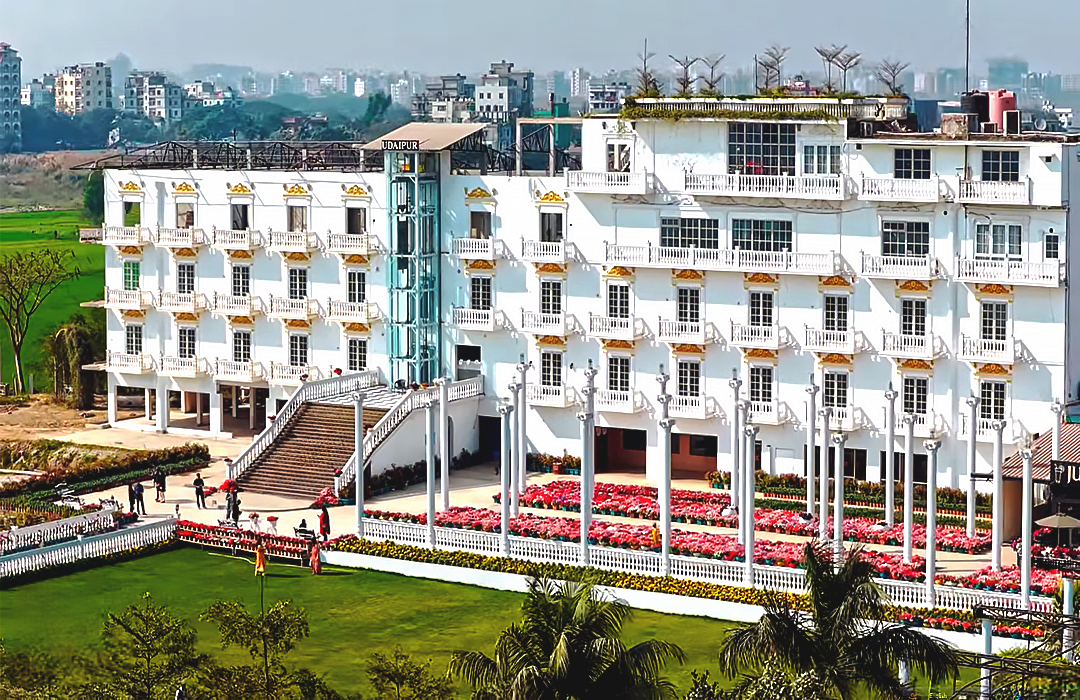
Image: Collected
There are places in this world that refuse to be mere coordinates on a map. They become feelings, repositories of memory, addresses where the soul goes to exhale. In a city that gasps for air beneath concrete and chaos, where every square foot battles between builder and dweller, such places are not just rare, they are mythical.
Yet, fifteen minutes from Gulshan’s glittering towers and gridlocked arteries, such a myth breathes.
I visited in what appears to be a geographical impossibility. A sweeping meadow of almost aggressive greenness, bordered by tranquil water bodies that mirror an uninterrupted sky. Children sprint across the grass with the kind of abandon that Dhaka has nearly forgotten. Families spread out picnic blankets. A couple walks hand-in-hand along a flower-lined path, their laughter carried on a breeze that smells of earth and possibility rather than diesel and desperation.
This is Udaipur destination, and it shouldn’t exist. But it does.
The place that was, the place that is
Those who have been paying attention to Dhaka’s evolving landscape of escape routes might recognize the bones of this place. This verdant expanse once operated under a different banner, Thikana Day Outours in Munshiganj, known for its vibrant flower gardens and promise of respite from the capital’s relentless urban pressure. But Udaipur represents something more ambitious than a rebranding exercise. It is a complete reimagining of what a nature-based tourist destination can offer to a population starved for space, silence, and sanity.
The transformation is evident the moment you pass through the entrance. Where Thikana offered a pleasant diversion, Udaipur presents an argument, that proximity to nature is not a luxury but a necessity, and that such proximity need not require a three-hour journey through highway traffic or a flight to Cox’s Bazar.
The grounds are meticulously landscaped with flower beds creating corridors of color, marigolds the color of sunset, roses in impossible purples and pinks, beds of petunias that seem to have been painted rather than planted. But unlike botanical gardens that feel curated to the point of sterility, Udaipur maintains an organic looseness. The grass is encouraged to grow tall in some sections. Trees are left to dictate their own shade patterns. The water bodies attract migratory birds that were clearly not part of any business plan but have become essential characters in the place’s daily narrative.
A democratic landscape
What strikes me most about Udaipur is its radical inclusivity. This is not a destination that caters to a specific demographic slice of Dhaka’s population. On Sunday afternoon I visited a remarkable cross-section of the city’s residents.
A corporate team occupies one of the designated business meeting spaces, a covered pavilion with WiFi, power outlets, and enough distance from other guests to allow for confidential discussions. They are young professionals, laptops open, but periodically distracted by the view in ways that conference rooms in Motijheel or Kawran Bazar could never accomplish.
Near the lake, an extended family has colonized several tables beneath a massive rain tree. Three generations are present, grandparents dispensing snacks from tiffin carriers, parents managing a complicated coordination of food and children, and kids who have formed an impromptu cricket team using sticks and a tennis ball. They have traveled from Mirpur, one of the mothers tells me, making this pilgrimage every few months ‘because the children need to remember what grass feels like’.
A photography crew is setting up for what appears to be a pre-wedding shoot, the couple in coordinated pastels against the natural backdrop. The photographer, a young man with the harried energy of someone managing both clients and creative vision, explains that Udaipur has become increasingly popular for such sessions. “The light here is different”, he said, gesturing broadly. “Softer. And the greenery doesn’t look staged, you know? It photographs like you’ve gone somewhere expensive, somewhere foreign”.
This democratic quality, the way the space accommodates office meetings and children’s birthday parties, romantic dinners and amateur football matches, feels almost revolutionary in a city where spaces are increasingly segregated by class and purpose.
The business of breathing
Bangladesh’s relationship with nature-based tourism occupies a peculiar position. We are a nation with natural advantages, the Sundarbans, the longest natural beach, hills that roll green in Sylhet and Bandarban, rivers that remain the blood vessels of commerce and connection. Yet for those living in Dhaka, accessing these natural wonders often requires significant investment of time, money, and planning.
The rise of destinations like Udaipur represents a pragmatic pivot, bringing the experience of nature to the outskirts of the city rather than requiring the city to journey to nature. It is tourism for the time-poor, the weekend-constrained, the parents who cannot orchestrate multi-day trips but desperately want their children to have memories that don’t exclusively feature shopping malls and traffic jams.
The business model is straightforward but requires execution precision. Advance booking is mandatory, a system that manages crowd density and ensures that the experience doesn’t degrade into the same crushing humanity that defines most public spaces in Dhaka. The booking process, handled via phone and digital platforms, includes detailed discussions about group size, purpose of visit, and specific requirements.
Pricing structures accommodate different visitor types. Day passes for families are affordable enough to encourage repeat visits. Corporate bookings for meetings or team-building exercises command premium rates but include dedicated spaces and catering packages. The candlelight dinner service, which transforms sections of the grounds into intimate dining experiences after sunset, represents the highest-tier offering, complete with customized menus and decorative setups that rival high-end restaurants.
What the place offers, what it promises
Walking the grounds, the facilities reveal themselves in layers.
Open seating areas scattered throughout, ranging from individual benches for those seeking solitude to large communal tables under tree canopies that can accommodate extended families or friend groups.
Designated play zones where children can run without the constant parental anxiety that defines playgrounds in Dhaka, will they fall into traffic, will someone snatch them, will they step on something dangerous?
Water features that serve multiple purposes, aesthetic focal points, habitat for local bird species, and psychological balm for visitors whose daily soundscape consists primarily of horns and construction.
Photography spots that have clearly been designed with Instagram in mind, decorative gates, flower walls, vintage bicycles artfully positioned, but which avoid the overtly artificial quality that makes such setups cringey.
Business meeting pavilions equipped with modern amenities but open to the environment in ways that make virtual meetings slightly surreal for participants calling in from conventional offices.
Dining facilities that range from casual snack counters to full-service restaurants capable of handling large group orders or intimate multi-course meals.
But beyond these tangible offerings, Udaipur trades in something more valuable with the promise of temporal escape. For a few hours, the grinding reality of Dhaka recedes. The air quality improves. The noise pollution diminishes to whispers and bird calls. The visual landscape shifts from advertising and concrete to horizon lines and organic forms.
The candlelight confession
The candlelight dinner service deserves particular attention because it represents Udaipur’s most ambitious attempt to create not just a destination but an experience that lingers in memory.
As evening descends, certain sections of the grounds transform. Tables are set with linens and flickering candles. Solar-powered fairy lights strung through trees create corridors of gentle illumination. The menu shifts from casual day fare to more elaborate options, steaks and grilled fish, pasta dishes and fusion preparations that attempt to balance sophistication with local palates.
I speak with a young couple who have booked this service for their anniversary. They are from Dhanmondi, both working professionals with demanding schedules. “We considered going to a nice restaurant”, the woman said, “but those places are just... more of Dhaka, you know? Same traffic to get there, same crowds, same enclosed spaces. Here, we can pretend we’ve traveled somewhere”.
Her partner adds, “And it’s not pretended, really. This is different. Real different”.
They are right. As darkness settles and the city’s glow becomes a distant suggestion on the horizon rather than an overwhelming presence, the transformation is complete. The same space that hosted children’s cricket matches in afternoon sun becomes something else entirely, intimate, romantic, almost impossibly peaceful.
The commute, the commitment
Getting to Udaipur requires navigation both practical and psychological. The physical journey begins at Notun Bazar in Dhaka, then proceeds via Madani Avenue toward Balu river. The route is straightforward enough for those familiar with the area, though first-timers benefit from GPS coordinates and specific landmarks.
But the psychological journey requires a different kind of navigation, a willingness to trust that something worthwhile exists outside the familiar circuits of urban life, that the time invested in getting there will yield returns that justify the effort.
This is not a trivial consideration in a city where time has become the most precious commodity, where every journey must be weighed against opportunity costs and alternative uses of those same hours.
Yet the visitors I speak with consistently frame the commute as part of the experience rather than an obstacle to it. The journey out of Dhaka’s dense core, watching the urban landscape gradually thin and green spaces emerge, functions as decompression, a gradual release of the city’s grip before arrival at a destination that feels psychologically, if not geographically, distant.
What this means, what it might become
Udaipur’s existence raises questions about Dhaka's future relationship with nature and recreation. If a destination like this can succeed on the capital's periphery, what does that suggest about demand for similar spaces? What does it reveal about the inadequacy of existing public parks and recreational facilities?
The answer seems clear: there is profound hunger for spaces that offer what Udaipur provides, enough room to breathe, enough green to soothe the eyes, enough distance from the city's relentless demands to allow for genuine rest.
This hunger creates opportunity. Already, similar projects are emerging around Dhaka’s outskirts, resort-style destinations promising nature, peace, and proximity. Some will succeed in creating genuine experiences. Others will prove to be merely commodified versions of escape, offering the appearance of respite without the substance.
What distinguishes Udaipur, at least in its current form, is a certain sincerity of purpose. The space feels designed by people who understand what the city does to its residents, the compression, the constant stimulation, the visual and auditory assault. It feels like an answer to a specific question: what would help?
The right to green
The mass media motto ‘Committed to People's Right to Know’, typically applies to information, to the revelation of hidden truths and suppressed facts. But there is another right that deserves commitment: the right to green spaces, to clean air, to horizons uninterrupted by construction.
These are not luxuries in cities like Dhaka. They are essential components of human wellbeing, as necessary as food and water and shelter. Yet they are increasingly treated as amenities, available only to those who can afford private access or afford to leave the city entirely.
Udaipur, whatever its commercial motivations, provides a form of democratized access. It is not free, few things of value are, but it is achievable for a broad spectrum of Dhaka's population. And in making itself achievable, it makes a case for its own necessity.
Standing at the edge of the property as evening approaches, watching families pack up their day’s adventures and couples settle in for candlelit dinners, I find myself thinking about what this place represents beyond its immediate offerings. It is evidence that Dhaka's residents refuse to accept the city's worst impulses as inevitable. That we will create spaces of respite even if they must exist in negotiation with commercial reality. That we remember what grass feels like, what clean air smells like, what silence sounds like.
Udaipur is not perfect. No place designed for profit can be. But it is necessary. And in a city that seems determined to eliminate every square meter of green in favor of gray, necessary is enough.
For now, it is enough to know that such places exist. That you can, with moderate planning and reasonable expense, give yourself and those you love a few hours outside the machine. That children can run. That adults can breathe. That memory can be made in greenness rather than concrete.
This is Udaipur’s promise, and for thousands of Dhaka residents seeking temporary escape from the permanent city, it is a promise worth keeping.
Best For: Families seeking open space for children, couples wanting intimate outdoor dining, corporate teams needing off-site meeting venues, photographers hunting for natural backdrops, and anyone requiring temporary amnesia regarding which city they actually live in.

Make Comment
Login to CommentPopular News




Subscribe to News Letter
Latest News