Regent flies electric Seaglider with crew for first time
 Desk Report
| Published: Saturday, September 05, 2026
Desk Report
| Published: Saturday, September 05, 2026
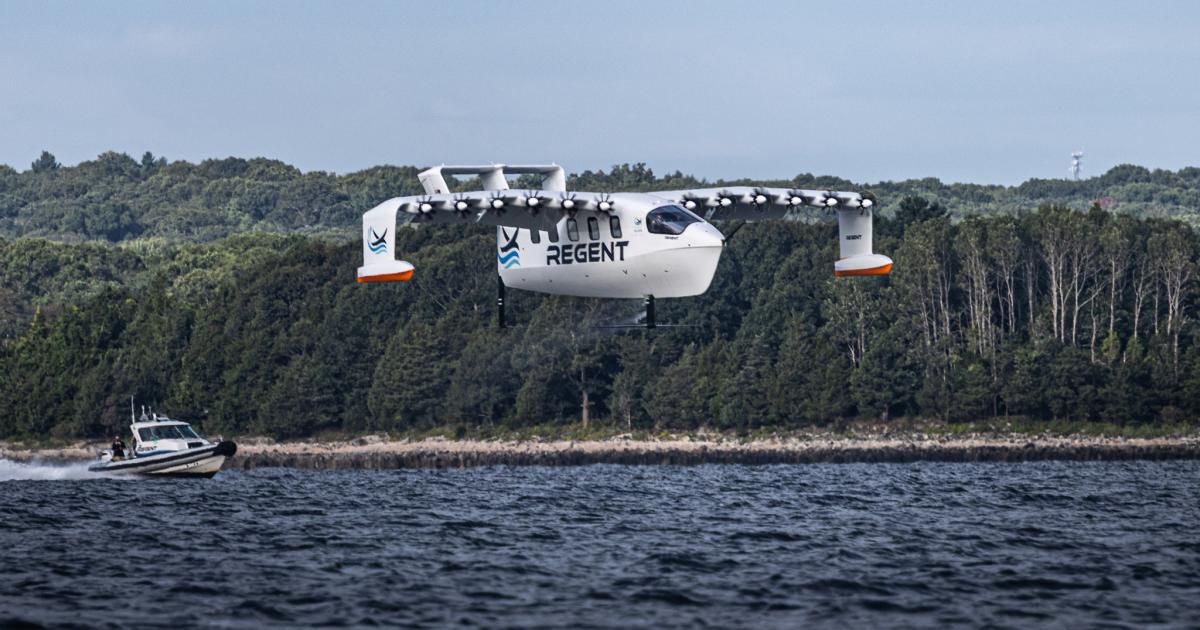
Phoot: Ainonline
Regent Craft has flown its full-scale Viceroy prototype with people on board for the first time, a milestone the North Kingstown, Rhode Island-based company said makes the vessel the largest all-electric wing-in-ground-effect craft ever to fly with a crew.
Two captains took the Viceroy 1,956 feet across Narragansett Bay at a height of 33 feet above the water on Wednesday, holding the flight for 30 seconds, according to Regent. The company called the test the start of its final stage of sea trials.
The Viceroy, which Regent classes as a seaglider rather than an aircraft, operates in three modes: It floats on its hull at low speed, rises onto hydrofoils once it leaves the dock, then flies within one wingspan of the water. At that height, the wing rides on a cushion of trapped air that cuts drag and stretches battery range, a phenomenon known as ground effect.
That approach keeps the seaglider under U.S. Coast Guard oversight rather than the FAA, and certified mariners operate it instead of licensed pilots. Regent filed its approval plan with the Coast Guard in March 2025.
Wednesday’s flight came six days after Regent disclosed a $240 million Series B round co-led by Mare Liberum and AE Ventures, bringing its total equity and debt raised to $340 million. In June, the company completed a 255,000-sq-ft factory in Quonset that will produce both the Viceroy and the smaller, uncrewed Squire.
Viceroys will seat 12 passengers and two crew, cruise at up to 180 mph, and cover up to 180 miles, according to Regent. Earlier this year, luxury travel operator The Twenty Five—Regent’s delivery and launch partner for seaglider operations in the Northeast and Southeast U.S.—committed to purchasing up to 60 Viceroys.
A parallel defense business has grown around the same design. The U.S. Marine Corps Warfighting Lab has funded seaglider work through two phases, starting with a $4.75 million contract for contested-logistics demonstrations and expanding to $15 million, according to Regent.
Marines used the Viceroy prototype in November 2025 to rehearse beach extractions, open-water raft pickups, and litter handling for medical and casualty evacuation missions. Military versions of the Viceroy will come in uncrewed and hybrid-electric configurations, the latter intended to push range past what batteries alone allow.
Squire, the smaller uncrewed variant, targets intelligence, surveillance, and reconnaissance work, light logistics, and search-and-rescue operations. It spent 13 days in July at Silent Swarm, a Navy electronic warfare experiment in Michigan, carrying payloads alongside uncrewed systems from across the U.S. military. Regent also holds a cooperative research and development agreement with U.S. Special Operations Command and has development ties to the Coast Guard.
“We’re now moving quickly toward production to deliver seagliders to coastlines around the world,” said Regent co-founder and CEO Billy Thalheimer.
Source: Ainonline

Make Comment
Login to CommentPopular News





Subscribe to News Letter
Latest News