Saudi aviation’s changing landscape: Riyadh Air and Saudia Airlines shape new era
 Desk Report
| Published: Sunday, August 23, 2026
Desk Report
| Published: Sunday, August 23, 2026
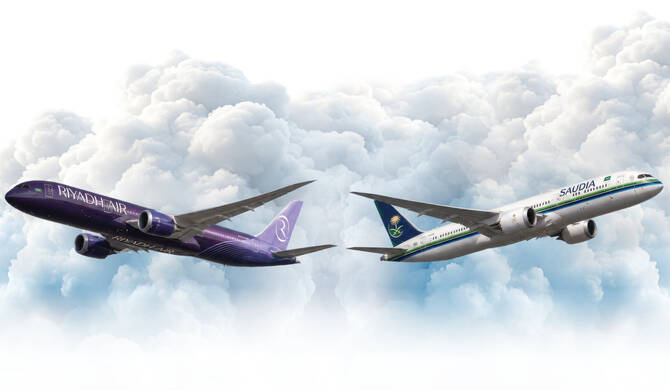
Saudi Arabia’s aviation sector is emerging into a new era as the Kingdom aims to expand its global connectivity through the introduction of Riyadh Air alongside the established Saudia Airlines.
The growth in the Kingdom’s airline sector has sparked conversation about the differences in airline suitability, destination availability, mile usage, and overall accessibility.
Under Vision 2030, the rollout of Riyadh Air aligns with a mission to expand tourism, foster global connectivity, and make the capital an international hub accessible to over 100 destinations.
While the existence of Saudia Airlines might imply competition between the two, their distinct offerings support complementary goals and allow the Kingdom to strive for greater global reach.
Competition good for all
Osamah Al-Nuaiser, SVP of marketing and corporate communications at Riyadh Air, told Arab News the airlines’ coexistence will create more room for connectivity, economic growth, trade, tourism, and investment.
He said, "The presence of two national carriers should be viewed within that broader growth story. Riyadh Air has a clear role: building connectivity through Riyadh and supporting the capital’s development as a major global aviation hub.”
Al-Nuaiser added, "As connectivity across the Kingdom increases, travelers will benefit from greater choice, more destinations, and improved access to Saudi Arabia, while the wider aviation ecosystem becomes more competitive and internationally connected.”
The official emphasized that each airline serves a distinct purpose, saying, "Riyadh Air is building its network around Riyadh as a global hub, while Saudia brings an established network and significant presence across the Kingdom.
“This creates more choice and potential travel pathways for both Saudi and international travelers.”
Speaking to Arab News, Khaled Tash, Saudia Group’s chief marketing officer, emphasized the expanding market as a positive development for Saudi aviation, highlighting a growing international network by 2030 as a core goal.
He said Saudia Airlines is working on strengthening connectivity through a capacity increase, adding, "We currently operate 153 aircrafts, with 112 additional aircrafts in the pipeline, and expect the fleet to reach 216 aircrafts by 2030.”
Tash also explained that cooperation between the two airlines extends to an already established framework that covers areas like interline and codeshare connectivity, which create further connectivity and itinerary options.
Regional boosts
Saudia Airlines, which has recently undergone marketing rebranding, continues to represent the Kingdom’s identity as a longstanding national carrier that has excelled since its founding in 1945.
The shift, however, comes from the airline's transition of its primary operational hub from Riyadh’s King Khalid International Airport to Jeddah’s King Abdulaziz International Airport, leaving Riyadh Air to operate its primary hub in the capital.
Al-Nuaiser said that the carrier’s proposition is not limited to Riyadh, despite it being the center of its network, and he highlighted Jeddah and the Eastern Province as important parts of Riyadh Air’s network.
Arved Von Zur Muehlen, chief commercial officer of Saudia Airlines, echoed Al-Nuaiser’s perspective on continuing to prioritize both Jeddah and Riyadh, despite Jeddah’s role becoming increasingly important for the airline.
Muehlen explained that the Eastern Province also plays a key role in Saudia’s network, with future capacity determined by demand, connectivity, and commercial performance.
Regarding Saudia’s major move from Riyadh to Jeddah, Muehlen told Arab News an increase in aircraft is central to help meet the Kingdom’s Vision 2030 ambitions.
“Under the current plan, the number of Jeddah-based aircrafts is expected to increase from approximately 102 in 2026 to around 186 by 2030,” he said.
Benefit schemes
The coexistence of both airlines offers customers opportunities to use and earn loyalty benefits through different avenues.
Riyadh Air’s loyalty program, Sfeer, has its own unique features, including points that do not expire and ones that are shared with family and friends, a feature that Al-Nuaiser claims will create a collective experience.
“As Riyadh Air grows, Sfeer will expand alongside it, bringing together travel with lifestyle benefits, local and international partners, exclusive experiences, and gamified engagement,” he added.
Early passenger experiences have pointed to areas of improvement in Riyadh Air’s digital sphere.
Sfeer member Yousef Ahmed described the airline’s app as “super buggy,” saying he was unable to check in digitally and had to complete the process at the airport.
Questions were also raised about the effectiveness of inflight WiFi, with Ahmed recounting an inconsistent experience with the service, saying that while it worked on his Riyadh-to-Jeddah flight, it did not on the return journey.
Saudia’s AlFursan loyalty program offers “Classic Flight Rewards” according to Kashmira Motiwalla, chief loyalty officer at the airline.
She told Arab News these are “highly sought after” and are often redeemed early, but members can still use “Cash + Miles” to reduce the cost of any available seat, even on their preferred flights.
“Through Saudia, Flyadeal, SkyTeam, and our global airline partner network, members have more choices than ever to earn and redeem miles for travel,” she said.
Like Riyadh Air’s offerings, concerns have also been raised about Saudia’s loyalty program, with AlFursan Gold member Marwan Tash telling Arab News of lounge overcrowding, especially in Jeddah, saying paid access for passengers outside Gold, Silver, and Business Class has made it difficult to find seating.
He also noted limited flexibility after using miles to upgrade a ticket, as changes can require cancellation and a refund of both the amount paid and the miles used.
Tash described Saudia’s onboard Wi-Fi connectivity as “very disappointing” compared with other leading airlines in the region.
Reflecting on that point, Essam Akhonbay, vice president of marketing at Saudia, told Arab News: “The service is already available on more than 40 aircrafts; all new aircrafts will enter operation equipped with connectivity, and we are targeting full fleet coverage by the end of 2027,” he said.
As guests seek flights in the coming times, they can be assured that the introduction of Riyadh Air is increasing overall capacity for the Kingdom, allowing Saudia Airlines to serve more passengers and for both airlines to work together.
Source: Arab News/Basmah Albasrawi

Make Comment
Login to CommentPopular News



Subscribe to News Letter
Latest News