US Air Force Eyes Next-Generation Airlifter Entry To Service By Early 2040s
 Desk Report
| Published: Tuesday, December 02, 2025
Desk Report
| Published: Tuesday, December 02, 2025
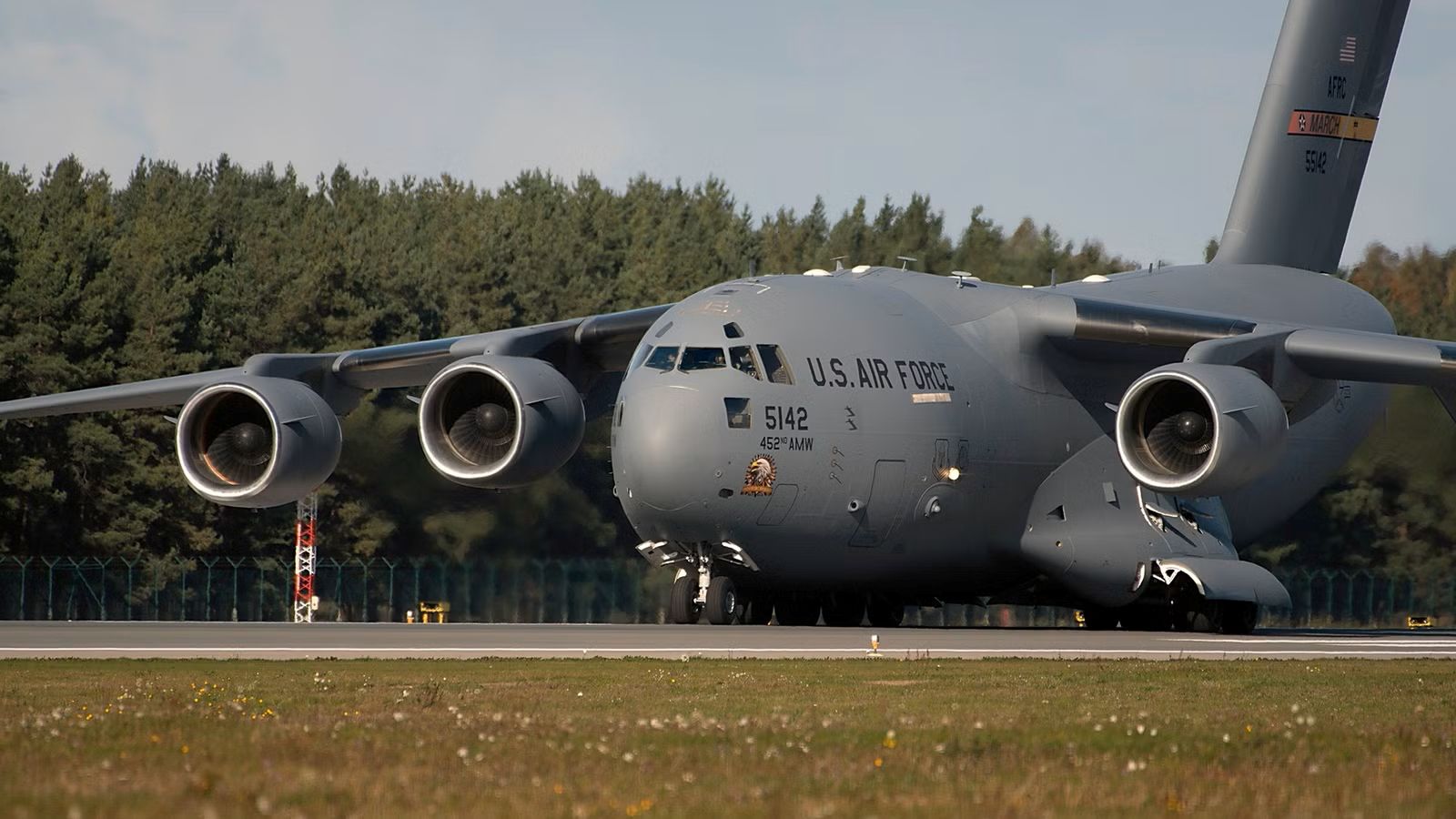
Photo: Shutterstock
The United States Air Force (USAF) aims to introduce its next-generation airlifter (NGAL) in the early 2040s. The NGAL program is still in the early stages of defining its requirements, but it has already emphasized the need for greater speed and enhanced operational flexibility. Ultimately, the new aircraft will be expected to replace both the Lockheed Martin C-5M Super Galaxy and the Boeing C-17A Globemaster III.
In the meantime, current airlift plans indicate that the Lockheed Martin C-5M Super Galaxy must remain operational through 2045, while the Boeing C-17A Globemaster III is expected to stay in service until 2075, according to the Air Mobility Command’s strategy memo released on November 19, 2025. The news was first reported by TWZ.
USAF Vision For The NGAL
The single NGAL platform is envisioned to replace and fulfill the roles of both the Boeing C-17A Globemaster III and the Lockheed Martin C-5M Super Galaxy. The program aims to modernize the NGAL’s capabilities so that it can operate with greater agility and speed and perform effectively in “higher threat environments,” Air Force Gen. John Lamontagne, head of AMC, told TWZ on the sidelines of the Air & Space Forces Association’s 2025 Air, Space, and Cyber Conference in September 2025.
The program aims to eventually retire both aircraft types, with the C-5M slated to be phased out first as the NGAL enters service. The C-17 Globemaster fleet will then be replaced by the NGAL on a one-for-one basis, according to the AMC memo. By the time the transition is complete, some C-17s could be up to 80 years old. The goal is for the NGAL to achieve Initial Operating Capability (IOC) around 2041, following an initial deployment no earlier than fiscal year 2038. In the memo, AMC stated, “With an accelerated NGAL Analysis of Alternatives (AoA) in FY27 and an uninterrupted acquisition process with consistent funding, the first NGAL aircraft could be produced as early as FY38. It is estimated the NGAL program will reach Initial Operational Capability (IOC) in FY41.”

How Many C-17s And C-5s Are In The USAF Fleet?
The McDonnell Douglas/Boeing C-17 Globemaster III and the Lockheed Martin C-5 Galaxy are the two largest strategic military airlifters in the USAF. The Globemaster III was originally developed for the USAF by McDonnell Douglas, with the first units entering service in 1995, just a couple of years before McDonnell Douglas merged with Boeing in 1997. The heavy airlifter was designed to replace the aging Lockheed C-141 Starlifter and to perform many of the same missions as the larger C-5 Galaxy.
While the C-5 Galaxy (the baseline model for the C-5M Super Galaxy) was never exported and remains exclusively operated by the USAF, the C-17 has been exported to US allies and partners. C-17 production continued until 2015. By the end of production, a total of 279 C-17s had been delivered to the USAF and to the air forces of the United Kingdom, Australia, India, Canada, Qatar, the UAE, and Kuwait. The C-17 is also used by the 12-nation Strategic Airlift Capability (SAC) multinational program. As of fiscal year 2025, the USAF operates 222 C-17As.
The C-5M, meanwhile, is a modernized version of the legacy C-5, designed and upgraded by Lockheed Martin. The USAF currently owns and operates 52 C-5B/C/M aircraft. The original production run for the C-5 Galaxy lasted from 1968 to 1989, with the aircraft entering service in 1970.
Key Performance Details
The C-17 can carry a maximum payload of 170,900 pounds (77,519 kg) and has a maximum takeoff weight of 585,000 pounds (265,352 kg), according to the US Air Force factsheet. When loaded with 164,900 pounds (74,797 kg) and cruising at an initial altitude of 28,000 feet (8,534 meters), it can fly about 2,400 nautical miles without refueling. The aircraft cruises at a speed of roughly 450 knots (517 mph).
The C-5M can carry a maximum of 281,001 pounds (127,460 kg) of cargo and fly up to 2,150 nautical miles. It can then unload and continue to a second base 500 nautical miles away without aerial refueling, according to an official US Air Force factsheet. With a lighter load of 120,000 pounds (54,431 kg), the C-5M can fly approximately 4,800 nautical miles, and it can reach about 7,000 nautical miles when empty. The aircraft’s maximum speed is 518 miles per hour.
Source: Simple Flying & TWZ

Make Comment
Login to CommentPopular News



Subscribe to News Letter
Latest News



Weather Outlook
Clear
Dhaka, Bangladesh
Wind: 7.2 kmph · Precip: 0 mm · Pressure: 1012 mb

19.9°C
Tue

22.3°C
Wed
22.1°C
Thu
21.6°C