INSIGHT STORY
8 decades of aviation legacy, grounded
Policy vacuum, governance failure and neglect ground Bangladesh’s oldest pilot nursery
When Bangladesh Flying Academy & General Aviation Ltd (BFA&GA) informed the Civil Aviation Authority of Bangladesh (CAAB) on June 28 that it was suspending operations for lack of funds, it was more than another struggling aviation business going offline.
It was the grounding of an institution dating back to 1948 - at precisely the moment Bangladesh is seeking to expand its aviation industry and will require a new generation of pilots to fly an expanding fleet.
An autopsy of the academy's decline points to a troubling combination: prolonged governance paralysis, financial distress, depletion of assets, operational and safety shortcomings and, critically, the absence of a coherent national policy to preserve and develop domestic pilot-training capacity.
From pilot nursery to grounded aircraft
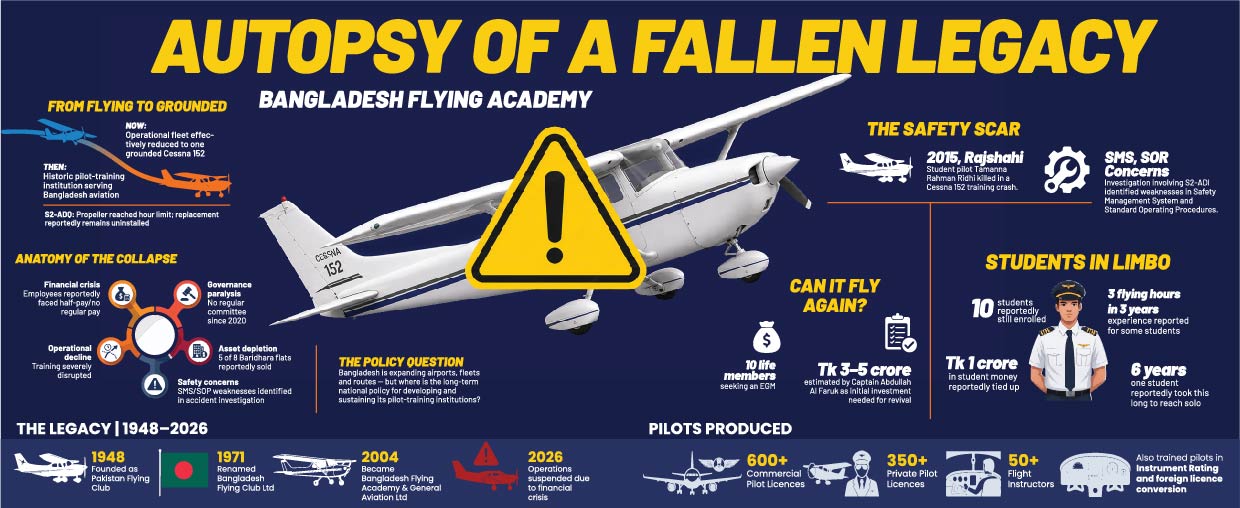
Established in October 1948 as Pakistan Flying Club, the institution became Bangladesh Flying Club Limited after independence and assumed its present name in 2004.
Over the decades, it produced more than 600 Commercial Pilot Licence holders, over 350 Private Pilot Licence holders and more than 50 flight instructors, alongside providing instrument ratings and foreign licence conversions.
Captain Abdullah Al Faruk, associated with the academy as a life member, estimates that it trained between 80 and 90% of pilots who went on to serve Biman Bangladesh Airlines, alongside aviators flying for US-Bangla Airlines and Novoair.
Yet today, its fleet has effectively shrunk to one grounded Cessna 152.
One aircraft, S2-ADQ, reportedly reached its propeller-hour limit. A replacement propeller was procured but remains uninstalled amid what insiders describe as administrative “complexities”.
The remaining aircraft, meanwhile, has allegedly received inadequate preservation attention while grounded.
Governance collapse
The deeper crisis appears institutional.
BFA&GA once operated through an organised structure with an elected president, general secretary and committee. Insiders say no regular committee has functioned since 2020 amid internal conflict and factionalism. Management has effectively been reduced to an Accountable Manager and a Secretary.
Employees, according to Captain Faruk, continued working for prolonged periods on half salary or without regular pay, hoping the academy would recover.
Meanwhile, permanent assets were progressively sold.
Of eight flats in Baridhara once owned by the academy, five have reportedly been sold. Two kathas of Dhanmondi land, estimated by insiders to be worth around Tk 8 crore, are also reportedly being processed for sale.
For a training institution that should ideally sustain operations through tuition and flying revenue, repeatedly liquidating property to survive raises an uncomfortable question: was the academy being rescued, or slowly dismantled?
Safety failures compounded decline
Operational difficulties were accompanied by safety concerns.
Training shifted to Rajshahi after restrictions prevented regular flying from Dhaka's international airport. But Rajshahi itself became associated with tragedy when student pilot Tamanna Rahman Ridhi was killed in a Cessna 152 crash in 2015.
An Aircraft Accident Investigation Committee investigation into another incident involving S2-ADI also identified weaknesses in the academy's Safety Management System and Standard Operating Procedures.
Such findings cannot be dismissed as merely consequences of financial hardship. Flight training is inherently safety-critical, and institutional heritage can never substitute for rigorous training standards, risk assessment and regulatory compliance.
Students pay the price
Behind the institutional collapse are students whose careers are now uncertain.
Around 10 students are reportedly still enrolled, with approximately Tk 1 crore of their money tied up with the academy.
The scale of operational paralysis is illustrated by individual cases cited by Captain Faruk: one student who enrolled in 2020 reportedly required six years merely to reach solo flying, while others managed only three flying hours over three years.
For aspiring pilots, such delays are not simply inconvenient. They consume money, time and critical career years.
Where was the national policy?
BFA&GA must shoulder responsibility for its governance, financial and operational failures. But its collapse also exposes a wider weakness in Bangladesh's aviation architecture.
Bangladesh wants more airlines, aircraft, routes and international gateways. Yet pilot training — the human infrastructure required to sustain that expansion — remains without the kind of long-term national framework afforded to physical airport infrastructure.
Aviation analyst ATM Nazrul Islam, himself a former flying academy chief executive, describes the closure as particularly painful.
“A flying academy is not merely a business entity; it is the craftsman behind future aviators and the foundation of a nation's aviation industry,” he said.
His concern goes to the heart of the issue: why should a country planning aviation expansion watch its oldest pilot-training institution collapse without first examining whether it can be professionally restructured?
Can the academy still fly?
Ten life members have sought an Emergency General Meeting to overhaul the existing structure and hold fresh elections. Proposals include government appointment of an administrator, investigation into asset disposals, constitutional reform towards CEO-led professional management and fresh investment.
Captain Faruk estimates Tk 3-5 crore, roughly enough for two training aircraft, could provide the foundation for restarting operations.
Whether that figure is sufficient requires independent scrutiny. Revival should not mean preserving dysfunction simply because the institution is historic.
But allowing an eight-decade-old academy to disappear without a transparent assessment would be equally shortsighted.
The lesson from BFA&GA's grounding is bigger than one institution: runways and aircraft alone cannot build an aviation nation. Bangladesh needs a policy for producing the people who fly them.

Make Comment
Login to CommentPopular News





Subscribe to News Letter
Latest News