Air Canada crash exposes chain of communication failures
Two pilots perish as Air Canada flight collides with fire truck on runway, exposing critical gaps in safety protocols and equipment at New York airport
 Desk Report
| Published: Monday, March 30, 2026
Desk Report
| Published: Monday, March 30, 2026
Dakota Santiago for The New York Times
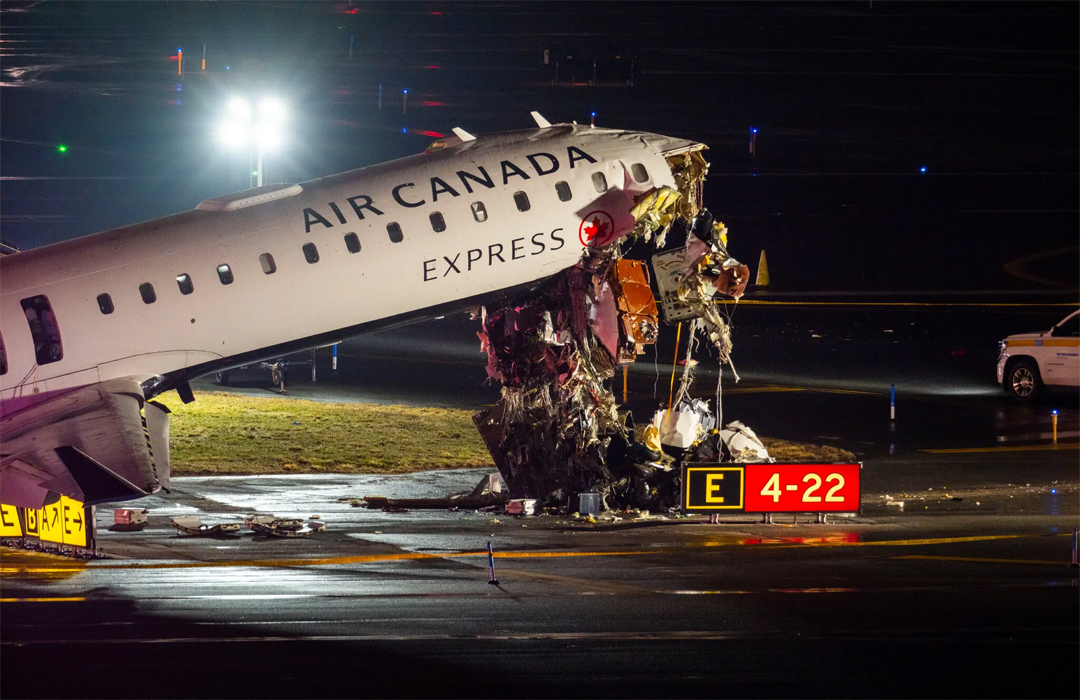
Two young Canadian pilots lost their lives when Air Canada Express Flight 8646 collided with a Port Authority fire truck on LaGuardia Airport's Runway 4 late on March 22, in the worst runway disaster at the airport in over three decades.
Antoine Forest, 30, and first officer Mackenzie Gunther, 24, were operating the Montreal to New York flight carrying 72 passengers when their Bombardier CRJ900 jet struck the fire truck at approximately 11:35pm during rainy and foggy conditions. Despite two deaths, no passengers were fatally injured, though 41 people required hospital treatment.
National Transportation Safety Board chairwoman Jennifer Homendy said, “When something goes wrong, that means many, many things went wrong”. Investigation revealed multiple systemic failures leading to the catastrophic collision.
Flight 8646 departed Montreal over two hours late at 10:12 pm. As the aircraft approached LaGuardia around 11:35pm, it received clearance to land on Runway 4. Meanwhile, Port Authority firefighters Sergeant Michael Orsillo and Officer Adrian Baez were responding to a United Airlines emergency call about strange odours sickening crew members.
At 11:37pm, controllers cleared fire Truck 1 to cross Runway 4 at Delta intersection. Crucially, the truck lacked a Vehicle Movement Area Transmitter, a tracking device recommended by Federal Aviation Administration and standard at many airports. Without this transponder, controllers could not monitor the truck's exact location.
Eleven seconds after clearing the truck, controllers realized the Air Canada flight was landing on the same runway. Tower recordings captured frantic commands, “Stop, stop, stop, stop, Truck 1, stop, stop, stop”. The warnings were repeated multiple times but the truck continued crossing.
Aviation consultant Kit Darby suggested firefighters may not have realized the stop command applied to them, noting, “You don't get cleared to cross and then told to ‘stop, stop, stop’. That never happens”.
Flight 8646 touched down at approximately 130 miles per hour. Passenger Rachel Mariotti described the landing as harder than usual. Pilot Forest, the more experienced crew member, took control and applied brakes forcefully. Seven seconds after touchdown, the aircraft smashed into the truck's side, flipping it over and collapsing the plane's nose.
Flight attendant Solange Tremblay, 25-year veteran, was ejected over 300 feet while still strapped to her jump seat. She survived with two shattered legs, fractured spine and multiple skin abrasions requiring grafts. Her daughter Sarah Lépine called it ‘a complete miracle’ that she survived being thrown such distance.
Passengers described orderly evacuation despite injuries. Nurse Rebecca Liquori said, “Everyone on the flight really worked together. Nobody was stampeding over anyone”. Passengers exited via wings, sliding or jumping four to five feet to ground.
Investigation continues examining multiple questions. Were two overnight air traffic controllers sufficient? Did emergency call from United flight distract controllers? Post-crash recordings captured a controller telling another pilot, ‘I messed up’, though context remains unclear.
Federal Aviation Administration fined Port Authority USD 35 lakh in 2013 for ‘egregious’ violations of federal training requirements for airport rescue officers. Following that, Port Authority reorganized airport rescue operations.
Port Authority Police Benevolent Association spokesman Bobby Egbert explained controller authority, “They’re God. You have to listen to their instruction. It’s sacrosanct. They control everything”. He noted that even during life-threatening emergencies, trucks must await clearance before moving between points.
Fire trucks at Port Authority airports can weigh up to 90 thousand pounds, exceeding the fully-loaded Air Canada aircraft's weight. Officers describe challenges navigating oversized vehicles in LaGuardia's confined space where ‘tires are taller than most people’.
Both firefighters survived, with Officer Baez released March 23 and Sergeant Orsillo released March 26. Their position in the cab, ahead of impact point, prevented worse injuries.
By March 26, four passengers and one flight attendant remained hospitalized. Ariella Blank, 20, seated in first row, was improving from serious head injury and beginning therapy. Bodies of Forest and Gunther returned to Canada on March 26 via Newark Liberty International Airport. Air traffic controller acknowledged the solemn occasion, asking pilots, “You have precious cargo on there, right?”
Runway 4 reopened March 26, restoring full airport operations. Investigation typically requires several weeks before preliminary findings emerge.
Source: The New York Times

Make Comment
Login to CommentPopular News




Subscribe to News Letter
Latest News