Cartographer of lost heritage: Eliza safeguards history’s future
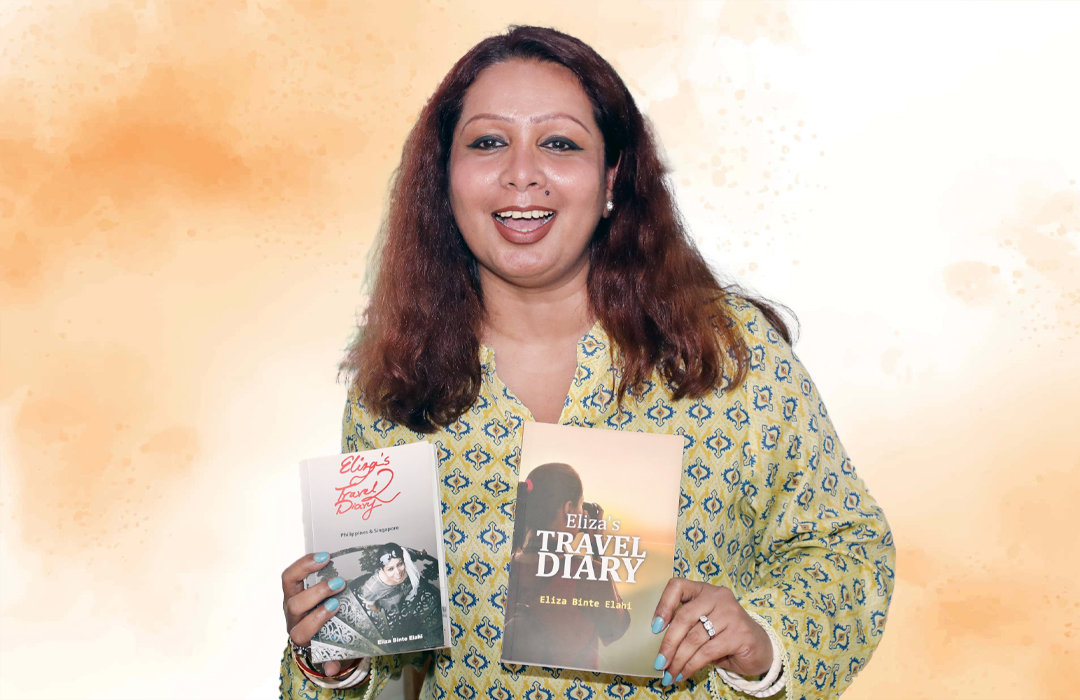
Image: Oheduzzaman Titu
In a dimly lit corner of The KFD Express last Friday afternoon, a woman stood before a gathering of Bangladesh’s travel writing royalty, Faruq M. Ahmed along with M. A. Latif, and confessed her deepest fear, “I am afraid to speak, because who really wants to listen to someone else talk so much?”
Yet for the next hour, no one moved.
Eliza Binte Elahi, carries the weight of Bangladesh’s disappearing architectural soul in her camera bag. Between 2016 and 2019, she traversed all 64 districts, alone, self-funded, obsessively, documenting the forgotten Buddhist viharas, crumbling hammamkhanas, and unmarked graves of Victorian balloonists that dot the Bangladeshi landscape like punctuation marks in a fading manuscript. Her mission wasn’t tourism in the commercial sense. It was rescue archaeology for a nation that has largely forgotten how to value its own past.
“When I first started talking about heritage tourism, people would turn their faces away”, Eliza recalled at the event titled ‘Elizar Sathe Vromon Adda’ (A Travel Chat with Eliza). “They’d ask, ‘What is that? What will come of it?’ We only understood tourism as mountains, rivers, and seas, everything together. The idea that you could work on separate fields of tourism… we didn't really know that”.
She did. And she went looking anyway.
The inheritance
Eliza’s journey began not with temples or tombs, but with a postcard. In 1977, when she was one year old, her father sent her a postcard from Russia. She still has it. That fragile rectangle of paper seeded a lifelong compulsion: to archive experience, to preserve the ephemeral.
By 1999, she was travelling the world. By 2008, she was a mother, a full-time professional, navigating the fractures between ambition and domestic reality. But somewhere between Mumbai and Masai Mara, a conviction took hold: Bangladesh's heritage wasn't just neglected, it was invisible. And if she didn’t document it now, it might vanish entirely.
In 2016, she launched Lost Heritage Journey of Bangladesh with her own money, her own time, her own stubborn faith. Three years. Sixty-four districts. Hundreds of crumbling structures photographed, catalogued, mapped. Some were inside restricted military zones. Some had no roads leading to them. Some existed only in 11th-century travelogues by Chinese monks.
She found them anyway.
“I realized that travel is an endless journey”, she said. “Especially in third-world countries like ours, where structures change year by year because they're in such poor condition. You think you're done, but then you need new information, a new photograph. In the age of digitalization, things get lost. Data disappears. You have to go back”.

The women history forgot
Eliza’s documentary work reads like a feminist counter-archive of South Asia. In Search of Ginetta, her 2018 film, resurrects the story of an Italian balloonist who died performing in Dhaka in 1892, pre-airplane, and was buried in an unmarked grave in Narinda Cemetery. The grave was rediscovered only recently by researcher Shamoem Aminur Rahman, whose own work Eliza documented in a companion film.
Then there’s Hariprobha Takeda, Dhaka’s First Modern Woman, about the first Bangali woman to travel to Japan, marry a Japanese man, and publish a Bangla travelogue, all before Rabindranath Tagore’s famous journey. Only one photograph of Hariprobha exists online. Eliza built an entire documentary around absence.
Her latest film, Leelabati Nag: Rebel, chronicles Dhaka’s first female student and educator, tracking her legacy across both Bangladeshi and Indian Bengal. The film won the National Film Award in 2023.
“Every travel narrative,” Eliza insists, “is tomorrow’s historical document. Ibn Battuta’s travel writing is now a historical archive. Hieun Tsang’s journey is the same. What we write today about Masai Mara will be history 50 years from now. I believe travel literature has no room for imagination”.
It’s a purist stance, almost ascetic in its discipline. Eliza doesn't write fiction. She writes memory. She archives experience.
The library that fits in one room
In a small room in her home, Eliza runs Vromon Pathagar (Travel Library), a collection of over 500 Bangla and international travel books, seeded by a gift from the late Hasnat Abdul Hye, one of Bangladesh’s foundational travel writers.
“He gave me 44 books from his collection”, she said. “But he had one condition that I create a travel library”.
She couldn’t afford a separate space. So, she carved out a corner of her life. Every Saturday, visitors trickle in. Journalists. Students. The travel-curious. They sit on the floor, perched on chairs, flipping through first editions and fading paperbacks. There’s no signage. No Instagram pages. Just books and belief.
The cost of caring
At Friday’s event, Faruq M. Ahmed, BRAC Bank executive and president of the gathering, acknowledged what everyone in the room already knew: “The level of dedication it takes to do what Eliza has done… even as someone from Chattogram, I didn’t know so much about my own city until she showed me”.
Eliza’s 2025 book Drisyomoy Chattogram (Visual Chattogram) emerged from a year-long documentation project across the port city’s archaeological sites, published by Okkhorbritto. She also has six other books, including travel diaries in English (Eliza’s Travel Diary I & II), African and Pamir chronicles, and oral history collections with figures like Brigadier General Shawkat Hossain.
But perhaps her most lasting contribution isn’t a book or a film. It’s the method. Eliza has quietly modeled a new kind of engaged scholarship for Bangladesh, one that values ground-level documentation over theoretical abstraction, visual evidence over inherited narrative, and slow, patient care over viral virality.
“Heritage tourism”, she said, “is about representing your country, developing the tourism industry, creating young entrepreneurs, and empowering women. These are all contemporary global concerns. And we can work on them.”
She paused. Smiled. “This work will continue until I die. Until my last breath, I want to keep documenting Bangladesh’s heritage”.
The room stayed silent. Not out of pity. Out of something rarer: recognition. That here was someone who had chosen, against all economic logic and social indifference, to become the keeper of a nation’s fading memory.
And in a country where so much is disposable, that choice, stubborn, solitary, sacred, felt like the most radical act of all.

Make Comment
Login to CommentPopular News



Subscribe to News Letter
Latest News