Cox’s Bazar International Airport jumps the gun
Nation’s longest runway set to inaugurate next month; tourism, city infrastructure, airline interest continue to fumble
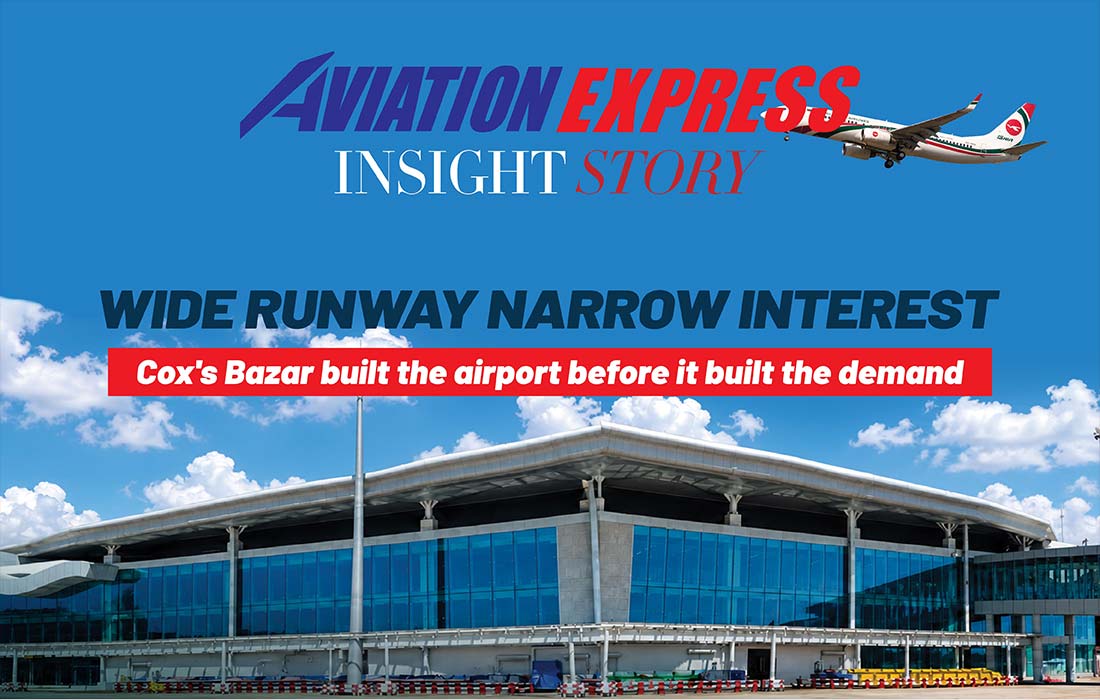
Bangladesh's Civil Aviation and Tourism Minister, M. Rashiduzzaman Millat, announced that Cox's Bazar International Airport will be inaugurated this October by Prime Minister Tarique Rahman, with Biman Bangladesh Airlines and "different international airlines" set to begin flying to the country's premier beach destination. Speaking to the Aviation and Tourism Journalists' Forum of Bangladesh in late August, Millat said several foreign carriers had "already expressed interest."
Before asking whether the airport opens on schedule, it's worth asking a more basic question: what has actually been built?

What has actually been built
The runway work dates to 2012, when CAAB extended it from 6,775 to 9,000 feet and widened it to 200 feet. A far larger upgrade, approved in November 2018, extended it further into the Bay of Bengal — the government's stated estimate at the time was Tk 1,568.86 crore. CAAB signed the construction contract in February 2021, adding 1,700 feet largely via land reclamation. That work, inaugurated later that year, is described by officials as the start of a "comprehensive development project" spanning both the runway and a new terminal.
The terminal ran on a separate contract, government-stated at roughly Tk 362 crore, designed to handle 1.8 million passengers annually. A further contract for additional runway work was cited in 2025 reporting at Tk 1,794 crore, targeted for completion in December 2026. These are the government's stated estimates at approval, not an audited final cost — CAAB has not published a consolidated total, and this piece does not attempt to reconcile one.
ATM Nazrul Islam, an aviation analyst, described the original premise: "The primary concept was that it would serve as a refuelling hub and a regional mini-tourism gateway," given Cox's Bazar's proximity to Myanmar, Indonesia and Malaysia, contingent, he added, on "complete supporting infrastructure for airlines to actually utilise it."
Why it was built this way
Air Vice Marshal (Retd.) Mafidur Rahman, the former Civil Aviation Authority of Bangladesh (CAAB) chairman, described the same tourism motivation, plus a rarely-discussed rationale: national security. Cox's Bazar sits at "a vital strategic position for safeguarding our maritime boundary and territorial airspace," he said, making a dual-use civil-military airport more cost-effective than a standalone military one. On the runway, he explained the engineering logic: widebody aircraft from Dhaka or Chittagong face "weight penalties" preventing full-load takeoffs, which the sea-extended runway was designed to eliminate. "Cox's Bazar Airport is not commercially viable for commercial airlines to operate at this moment," he added, "but the motivation stems from a long-term strategic vision focused primarily on unlocking tourism, and the upcoming Matarbari deep-sea port."
Regulatory and operational readiness
Mafidur Rahman was direct on current readiness: "In one word: No." A new terminal building is being prepared for international operation, but until complete safety and security standards are met, support services are integrated, and border control processes and clear sterile zones are set up, the airport is not operationally fit to be declared a full international gateway. He added that CAAB, at this moment, may face a challenge to spare sufficient trained air traffic controllers, with staff stretched across current operations and Dhaka's upcoming Terminal 3.
On compliance, he pointed to ICAO Annex 14's Obstacle Limitation Surfaces (OLS), which require a 500-foot obstruction-free clearance around the airfield — a standard Cox's Bazar doesn't meet. Establishments sit within that zone outside the airport fence, which CAAB had asked the civil administration, several times, through the Ministry of Civil Aviation and Tourism, to demolish. Inside the airport, the old terminal, an old fire-vehicle shed, and land held by another government body still need relocating. All of it, he said, should be cleared before October, "otherwise, during the next ICAO audit, Bangladesh risks receiving an ICAO safety concern," tarnishing the country's image. No longer in the chair, Rahman said he wasn’t certain whether actions have been taken, but believes the obstructions remain.
Nazrul Islam’s checklist for readiness went beyond the runway and terminal: navigation and air-traffic systems, immigration, customs and security processing, ground handling, cargo, fuel supply, and landside connectivity. "Capacity is not traffic," he said. "A long runway is an asset, but an airline does not operate an aircraft simply because a runway is available."
The view from an airline
Kamrul Islam, General Manager of Public Relations at US-Bangla Airlines, said little changes with a gazette notification alone: "Full recognition as an international airport will only come when foreign airlines actually begin operating flights." For a carrier like his, "there is very little likelihood of finding enough passenger volume" for onward routes to Bangkok, Kuala Lumpur or Kolkata since Chittagong draws from a wide catchment while Cox's Bazar "relies almost exclusively on local... passengers." He questioned whether Cox's Bazar has "truly reached the level of a complete tourist destination."
Nazrul Islam frames the commercial calculus in policy terms: competitive, predictable landing and passenger charges "at least during the initial years," flexible traffic rights, and convenient slots. On sequencing: "airlines should be involved before the airport opens, not after."
National flag carrier Biman's only proposed international route from Cox's Bazar is to Kolkata, that too, via Dhaka. Air Arabia showed interest
Optimism, with gaps beneath it
Not everyone shares caution. Anwar Kamal, President of the Tour Operators Association of Cox's Bazar, called the launch "a hopeful beacon" for new revenue across the local economy. Mohammad Rafeuzzaman, former Tour Operators Association of Bangladesh (TOAB) president, sees an underexploited market in landlocked neighbours. "Nepal and Bhutan have no sea or beaches", he explained. He also hopes for transit tourism from long-haul layovers.
Current figures, however, demonstrate tourist demographics leaning heavily towards domestic. Nazrul Islam recalled "over 90%... domestic tourists, while foreign tourists make up less than 10%." On hotels specifically, Mukim Khan, General Secretary of the Cox's Bazar Hotel-Motel-Resort Owners' Association, said, "hotel availability is not the issue" — citing existing 5-star and 4-star capacity — but overall destination management needs attention. Kamrul Islam cited the absence of entertainment, nightlife, water sports, and visa-on-arrival options.
Kamal named further gaps — no government-managed tourist-demographics database, "severely limited" currency exchange, and no dedicated hospitality training centres, despite roughly 1,000 hotels between Cox's Bazar and St. Martin's Island.
Rafeuzzaman had previously argued that tourism needs its own standalone ministry; civil aviation and tourism currently share one, with tourism's budget share reported at around 10% out of the ministry’s total budget allocation. TOAB has long pushed for a dedicated foreign-tourist zone with international-standard nightlife and recreation. Khan proposes phased routes toward Malaysia, Saudi Arabia, Dubai and the Maldives, leveraging existing expatriate communities, paired with promotional fares and marketing.
Nazrul Islam sees a pattern: "Sylhet was declared international to serve London expatriates, but foreign carriers never came. If you don't build the surrounding ecosystem, declaring an airport 'international' achieves very little."
What comes next
Mafidur Rahman explained that if the present government is really determined to make this a tourism hub, then making Cox’s Bazar an international airport is the right choice, but it is imperative to fix the encroachments, operational and staffing gaps first, and hold off on full international operations until ICAO's requirements are genuinely met. Nazrul Islam frames success differently — not the declaration, but "how many international operators come, how frequently they operate... and whether the airport generates sustainable passenger and cargo traffic." Treating the project "only as an airport project" risks Bangladesh ending up "with excellent infrastructure but insufficient utilisation like other two international airports."
Kamrul Islam shared a hopeful note: "We as airline professionals hope Cox's Bazar will be transformed into a full-fledged tourist destination," acknowledging that since the government decided to make it an international airport, they likely did so as part of a broader overarching plan.
The signal worth watching this October isn't the ribbon-cutting — it's whether an airline puts Cox's Bazar into a published international schedule, and whether that schedule holds.

Make Comment
Login to CommentPopular News





Subscribe to News Letter
Latest News