RUNWAY REALITY
Dhaka’s hub ambition hits a runway wall
HSIA’s new terminal will raise passenger-handling capacity, but a single operational runway, limited airline connectivity and wider infrastructure constraints threaten the hub ambitions
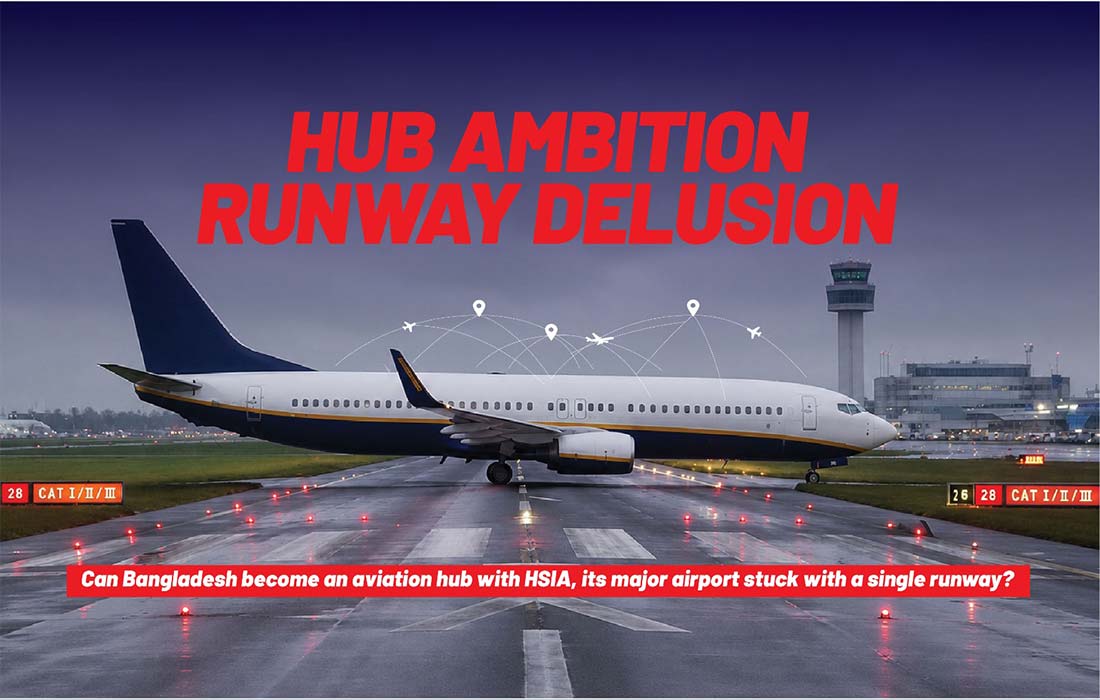
Since early 2026, the civil aviation and tourism ministry has framed policy around a grand ambition: transforming Hazrat Shahjalal International Airport (HSIA) into a global hub. This vision centres on long-awaited Terminal 3, a Tk 21,000 crore JICA-funded project, aspiring to open on December 16, 2026. While elevating annual passenger capacity to 20–24 million, the new terminal only expands terminal throughput such as check-in, immigration, boarding bridges and luggage belts. It adds no slots for flight movements, forcing every aircraft through the ultimate physical bottleneck: a single active runway.
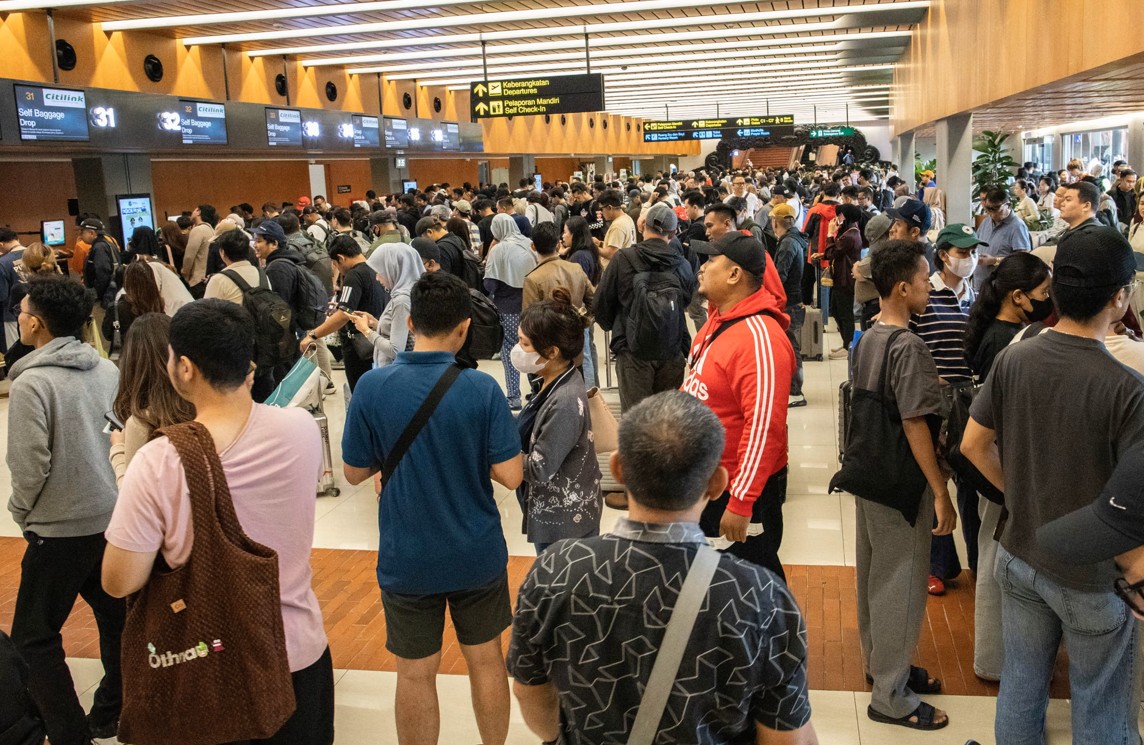
The technical bottleneck is severe. In 2025, HSIA squeezed 12.72 million passengers and an average of around 160 to 170 daily flights through a single strip. Squeezing 24 million passengers through the same runway requires doubling flight frequencies, which aviation analyst ATM Nazrul Islam calls a "massive struggle". He warns that trying to double frequencies on a single runway will paralyse operations, noting that aircraft already face taxiway queues of 30 to 40 minutes.
Though a second runway was approved, urban density restricts its placement. Under ICAO guidelines, parallel runways require a centerline separation of at least 1,035 meters to operate independently and simultaneously. Because Dhaka has encroached heavily on the airport's vicinity, CAAB can only fit a second runway 359 meters from the first, were HSIA to get a second runway.

Air Vice Marshall Muhammad Mafidur Rahman, former Chairman of CAAB, explains that this narrow separation would force any secondary runway to operate strictly in a dependent mode. Because the runways cannot operate simultaneously, the second strip would act merely as an expensive safety backup rather than a capacity multiplier, replicating dependent-runway limitations frequently witnessed in Karachi and Mumbai.
Despite this, Mafidur Rahman argues that a second dependent runway is technically "imperative" for safety and maintenance. HSIA's runway is due for a major overhaul in 2026–2027, currently kept functional only by night-time patchwork.
A second runway would allow CAAB to shut the main strip for rehabilitation and provide the daily 2-hour maintenance window required to declare Instrumental Landing System (ILS) Category II status. It would also serve as a vital safety alternate; if an aircraft blocks the main runway, it halts all international traffic into Dhaka.
To maximise the single runway, ATM Nazrul Islam suggests aggressive operational optimisation. He argues that smart, selective aviation management can expand capacity by 20% to 25%. This includes shifting helicopter operations—which account for 12% of HSIA's traffic—away from the main runway. Upgrading Air Traffic Management (ATM) and Instrument Landing System (ILS) software can shave one to two minutes off runway occupancy times per landing. Additionally, automated tarmac software to manage gate pushbacks would ease ground congestion. High-speed taxiways and runway connectors, provisions that are coming with Terminal 3, will assist, but only if paired with these digital routing systems.
Dhaka’s configuration contrasts sharply with global benchmarks. Mafidur Rahman notes that India's Mumbai Airport handles over 50 million passengers annually on a single runway, while Gatwick and Fukuoka process over 40 million. However, these airports run with surgical, automated air traffic precision that Dhaka cannot currently match. Conversely, true global hubs—such as Singapore’s Changi, Dubai, and Istanbul—deliberately resolved runway capacity to sustain their hub-and-spoke networks. Istanbul operates three fully independent parallel runways, and two backup runways, while Changi has certified two independent runways with a third in progress. These examples demonstrate that true hub status is built upon runway redundancy, which none of Bangladesh’s airports currently has in the pipeline, and not merely terminal aesthetics, which analysts apprehend may ultimately be the extent to which Terminal 3 delivers on the promise of hub status.
Other indirect factors further complicate Dhaka’s ambitions. True hubs require a coordinated ‘spoke-and-hub’ airline network, yet local carriers operate a reversed fleet structure: Biman lacks of widebody aircraft, while US-Bangla is range-limited. This is compounded by high transit fees ($20–$26 for transit visas), volatile jet fuel pricing, Biman’s ground-handling monopoly, and hundreds of building-height violations along the approach paths. Beyond the aerodrome itself, Dhaka’s ambitions are further constrained by the city’s relentless traffic congestion and its mismanagement, inadequate public safety and law-and-order environment, incomplete tourism infrastructure to attract transit tourists, and limited availability of comfortable overnight accommodation for transit passengers.
Ultimately, HSIA is projected to hit its absolute passenger ceiling of 20-24 million by 2035. This makes Terminal 3 a temporary cushion, not a permanent solution. Spending Tk 21,000 crore on an iconic terminal with a shelf-life of less than twenty years is highly questionable. An adequate facility could have been built at the HSIA’s existing T1 and T2 for as low as Tk 10,000 crore, according to Nazrul Islam. This would have been a sufficient enough cushion and freed up funds for a much-needed new airport. However, because building a brand-new airport would take ten years at the least, Bangladesh must immediately launch site selection for a dedicated, multi-runway 'Aviation City' away from Dhaka’s urban sprawl, ensuring its aviation dreams are not permanently grounded by a single strip of concrete.

Make Comment
Login to CommentPopular News




Subscribe to News Letter
Latest News