CAAB admits service failures at Cox’s Bazar airport
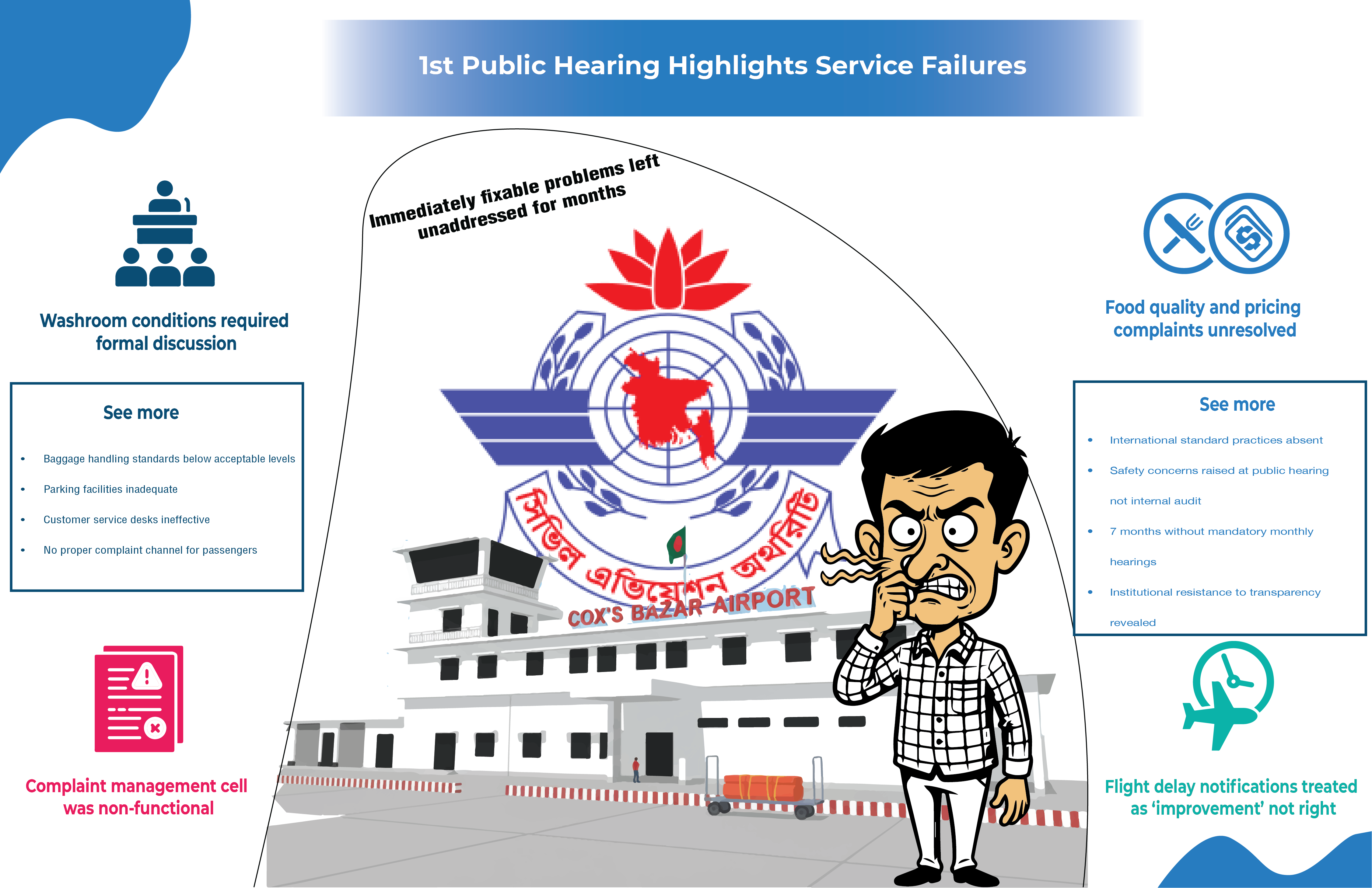
Illustration: Aviation Express
Official press release informed poor facilities, flight
delays, complaint issues as CAAB delays hearing 219 days.
Civil Aviation Authority of Bangladesh (CAAB) inadvertently
exposed systematic service failures at Cox’s Bazar Airport through its own
press release announcing the first public hearing held on Friday, 219 days
after the government mandated monthly sessions.
Press release issued by Muhammad Kawsar Mahmud, Assistant
Director for Public Relations, listed extensive complaints requiring discussion
including washroom conditions, food pricing, baggage handling, cleanliness,
parking facilities, flight delays and complaint resolution procedures.
The comprehensive list of basic service failures raises critical
questions about CAAB's oversight and accountability.
If airport services were functioning adequately, authorities
would not need lengthy discussions about washroom cleanliness, drinking water
quality and waiting lounge conditions. These are fundamental requirements at
any transport facility, yet Cox's Bazar Airport apparently failed to maintain
even minimum standards until passengers formally complained at a
government-mandated hearing.
Last year, on June 20, Chief Adviser's office decided to
expedite implementation of Public Administration Reform Commission
recommendations. Decision came from a high-level meeting that selected 8
proposals from 121 immediately implementable recommendations. Regular public
hearings featured among priority proposals deemed relatively easier to
implement.
Cabinet Division was instructed to meet all
service-providing ministries and departments within one week to develop a
public hearing strategy. However, CAAB conducted its first session only on January
29 this year, delaying the monthly requirement for seven consecutive months.
This delay suggests resistance to transparency and accountability measures.
Most damning aspect of the press release is CAAB’s promise
that ‘immediately resolvable issues would be addressed promptly’. This
admission raises questions. If certain problems can be fixed immediately, why
did they exist in the first place? Why were passengers subjected to substandard
washrooms, overpriced food and inadequate facilities when solutions were
readily available?
Evidence suggests CAAB knew about these problems but chose
to ignore them until forced to hold public hearings. Authorities apparently
lacked motivation to address passenger complaints until government directive
made transparency mandatory.
Press release revealed plans to ‘activate’ the complaint
management cell, exposing another failure. This phrasing confirms the cell
existed on paper but remained non-functional. Passengers had no proper channel
to lodge complaints about service quality, leaving them helpless against poor
conditions. System designed to protect passenger rights was deliberately left
inactive.
S M Lablur Rahman, Additional Secretary and CAAB Member for
Administration, attended hearing alongside Air Commodore Md Noor-e-Alam and
other senior officials. During discussions, airline representatives were
reminded of their ‘responsible role’ in providing ‘prior notification to
passengers in cases of flight delays or cancellations.’
This discussion point reveals that prior notification for
flight delays is treated as an improvement or special consideration rather than
a basic passenger right. International airports worldwide consider timely
communication about schedule changes as standard practice, not an enhancement.
That CAAB discusses this as progress exposes current negligence in passenger
service standards.
Participants also highlighted needs for ‘strengthening
coordination among airport-related agencies,’ ‘improving effectiveness of
customer service desks’ and ‘simplification of complaint resolution procedures.’
Each phrase confirms existing systems are inadequate, poorly coordinated or
unnecessarily complex.
Infrastructure concerns discussed included runway and apron
management, fire and rescue preparedness and emergency response coordination.
These critical safety matters being raised at a public hearing rather than
through routine audits and inspections raises serious questions about CAAB's
operational standards.
Cox’s Bazar Airport Director for Research and Development Md
Golam Mortoza Hossain chaired the program attended by passengers, media
representatives, airline officials and stakeholders. Officials expressed
optimism that public hearings would enhance transparency and accountability.
However, 219-day delay in implementing a straightforward
government directive already undermines these claims. CAAB's failure to comply
with Cabinet Division’s timeline demonstrates reluctance to embrace reform.
Pattern of ignored problems, inactive complaint systems and delayed action
suggests institutional resistance to accountability rather than commitment to
passenger service quality.
Officials acknowledged long-term and policy-level matters
would be implemented gradually through coordination with relevant authorities.
Given CAAB’s track record of delays and neglect, passengers have little reason
for optimism about meaningful improvements.

Make Comment
Login to CommentPopular News




Subscribe to News Letter
Latest News