COMPLIANCE CRISIS
Can Bangladesh avoid an ICAO safety red flag?
Manpower shortages, regulatory gaps and training delays threaten Bangladesh's ICAO audit preparedness and aviation ambitions
(Symbolic image)
Bangladesh has gained valuable breathing space after the International Civil Aviation Organization (ICAO) postponed its next comprehensive aviation safety oversight audit until October 2027. But aviation insiders warned that the delay has not solved the country's underlying problems. Instead, it has exposed how much work remains unfinished.
An ICAO’s pre-audit mission, scheduled for December this year is expected to provide the first real indication of whether Bangladesh is on track to meet international safety oversight standards or is drifting toward one of the most serious findings in global aviation regulation: a Significant Safety Concern (SSC).
More than an audit
ICAO audits are not examinations that can be passed through last-minute preparation. They evaluate whether a country's aviation regulator possesses the legal authority, technical competence, qualified personnel and operational systems required to oversee aviation safety effectively.
The audit examines eight critical elements, including legislation, regulations, organisational structure, technical guidance, personnel qualifications, certification procedures, surveillance systems and the ability to resolve safety issues.
A weak score in any of these areas can raise serious questions about a regulator's effectiveness. Former CAAB Chairman Air Vice Marshal (retd.) Muhammad Mafidur Rahman, who oversaw earlier audit preparations, cautioned against assuming that the postponement automatically improves Bangladesh's prospects.
"It is a misconception to think that simply because the audit is delayed, we will be better prepared," he said. "ICAO standards continue to evolve. If we fail to keep pace with those changes, we may remain behind despite having more time."
The inspector crisis
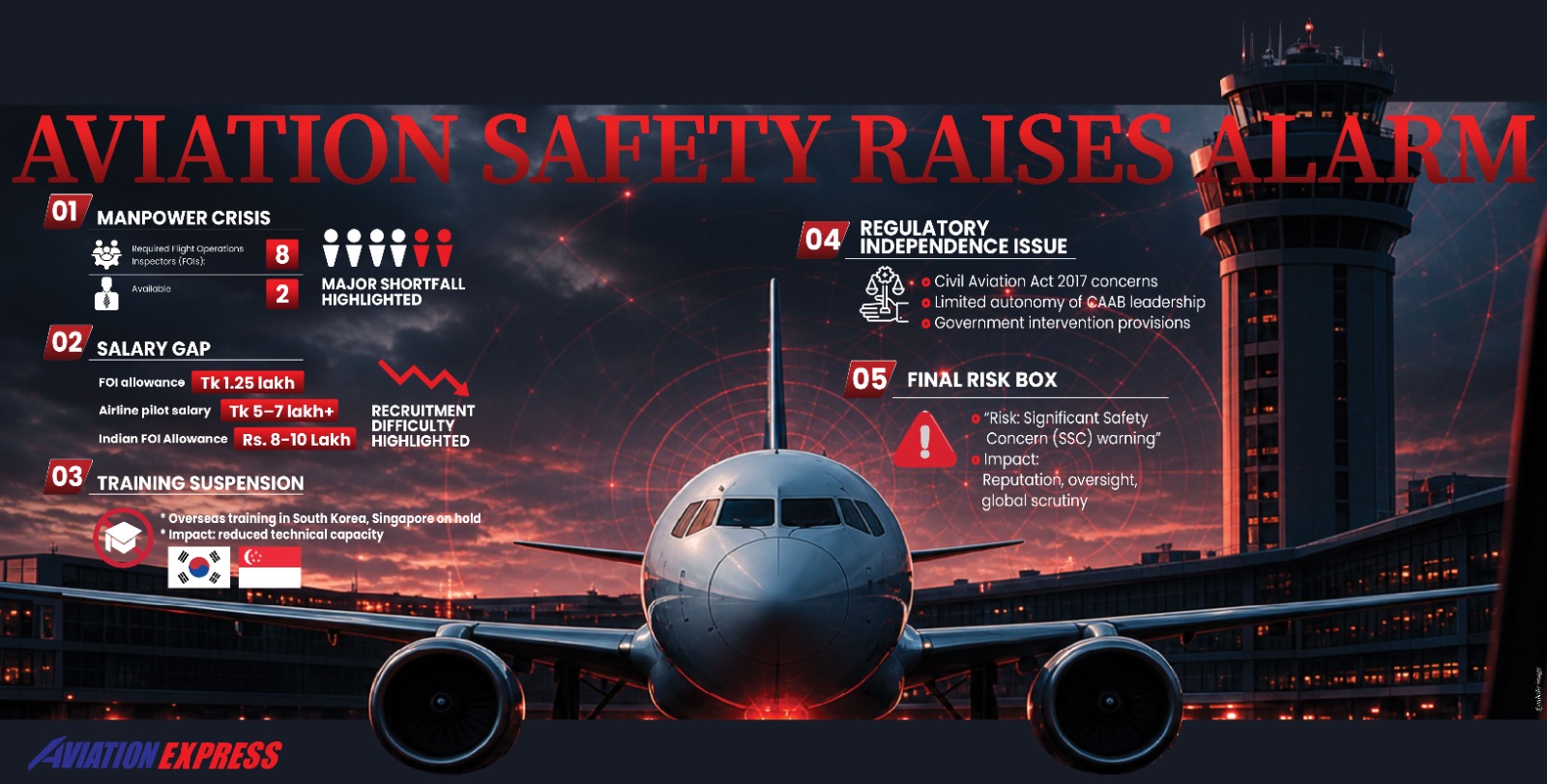
Perhaps the most immediate challenge facing the Civil Aviation Authority of Bangladesh (CAAB) is its acute shortage of Flight Operations Inspectors (FOIs), the specialists responsible for monitoring airline operations and ensuring compliance with international safety standards.
According to officials familiar with the preparations, CAAB requires at least eight inspectors. It currently has only two. The reason is largely financial.
Experienced airline pilots who qualify for inspector positions can earn between Tk 5 lakh and Tk 7 lakh per month in commercial aviation. CAAB's inspector allowance stands at roughly Tk 1.25 lakh.
The result is predictable: qualified professionals are reluctant to leave airline careers for regulatory positions. "This is not a new problem," said one senior CAAB official. "We have struggled for years to attract and retain inspectors."
Rahman argued that the issue reflects a deeper misunderstanding of aviation oversight.
"You cannot produce a flight inspector overnight," he said. "These professionals require years of operational experience. Recruitment must be continuous. Unfortunately, our system has failed to develop and retain experts."
Training freeze raises new concerns
Officials involved in audit preparations said another major obstacle is the suspension of overseas training programmes following government restrictions on foreign travel.
Several technical training initiatives in countries such as Singapore and South Korea remain awaiting approval. For aviation regulators, continuous international training is not a luxury but a requirement. Inspectors must remain current with evolving aircraft technologies, operational procedures and international regulatory standards.
The former CAAB chief believed this issue reflects a broader lack of understanding within the bureaucracy.
"ICAO expects member states to continuously update their experts through seminars and training programmes," he said. "But administrators often do not understand why aviation professionals require repeated training. That mindset has become a major obstacle."
Officials feared that without specialised training, Bangladesh may struggle to demonstrate the technical competency expected by ICAO auditors.
The independence questions
Beyond manpower and training, questions are emerging over the Civil Aviation Act, 2017.
Officials involved in preparations argued that the law does not provide CAAB with the degree of regulatory independence expected under international best practices.
Several provisions allow intervention by the Ministry of Civil Aviation and Tourism in regulatory matters. Aviation experts said ICAO places significant emphasis on the ability of regulators to make technical and safety decisions free from external influence.
"The first thing ICAO examines is legality," Mafidur Rahman explained. "The law must empower the regulator to function independently. Some provisions in our existing legislation remain questionable from that perspective."
According to CAAB officials, a draft amendment to the Civil Aviation Act has already been forwarded to the Ministry of Civil Aviation and Tourism to address concerns over regulatory autonomy and enhance the independence of the CAAB chairman ahead of the next ICAO safety oversight audit.
What happens if Bangladesh receives an SSC?
An SSC is not a routine audit finding. It is issued when ICAO determines that a state has failed to exercise effective safety oversight in accordance with international standards.
Such a finding would not automatically ground aircraft or suspend international operations. But experts warned that the consequences could be severe.
Foreign regulators may increase scrutiny of Bangladeshi aviation activities. Airlines could face additional oversight. Commercial partnerships and codeshare agreements could become more difficult to secure. Insurers and aircraft lessors may also reassess risk profiles.
Mafidur Rahman believes the long-term reputational damage could be even more serious. "If we fail, the country's image will suffer tremendously," he said. "Many international airlines may reconsider operations. It would directly affect our ambition to become an aviation hub and could discourage investment."
Industry experts pointed to the country's inability to achieve the regulatory status required for direct Biman flights to the United States as an example of how oversight deficiencies can limit growth opportunities.
A window of opportunity
Aviation analyst ATM Nazrul Islam described the additional time as an opportunity, if used wisely. "This is not an examination where someone comes to fail you," he said. "ICAO wants to see whether you are implementing your own regulations properly."
He argued that CAAB should immediately undertake a comprehensive gap analysis, recruit missing inspectors, engage international consultants where necessary and conduct rigorous internal audits.
Most importantly, he said, the regulator must involve industry stakeholders. "Airlines, operators and regulators all succeed or fail together," he said. "Preparation cannot be limited to CAAB headquarters."
Race against clock
The December pre-audit mission is now viewed as the first major test. The ICAO team will assess Bangladesh's progress, identify remaining weaknesses and determine whether corrective actions are moving in the right direction.
For CAAB, the challenge extends beyond passing an audit. The regulator must demonstrate that Bangladesh possesses the institutional strength, technical expertise and governance structure necessary to sustain international safety standards.
Whether the country emerges stronger or finds itself confronting an avoidable safety concern, will depend on decisions made long before the auditors arrive.

Make Comment
Login to CommentPopular News





Subscribe to News Letter
Latest News