Chinese envoy stresses political unity, social stability for sustained development
 Senior Reporter
| Published: Monday, August 03, 2026
Senior Reporter
| Published: Monday, August 03, 2026
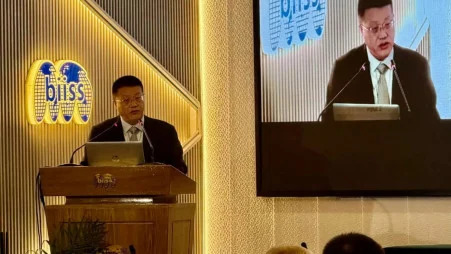
Photo: Collected
Chinese Ambassador to Bangladesh Yao Wen today said maintaining political unity and social stability, diversifying the economy beyond a single-industry structure and fostering a more favourable external environment are key governance challenges Bangladesh needs to address to sustain its development momentum.
Speaking at the inaugural session of the four-day "Comparative Governance Forum 2026" at the Bangladesh Institute of International and Strategic Studies (BIISS), the envoy also praised Prime Minister Tarique Rahman's people-centred, pragmatic and efficient style of governance, saying it has brought "a fresh look" to national governance.
Prime Minister's Foreign Affairs Adviser Humaiun Kobir attended the programme as the chief guest, while Fudan University Vice-President Professor Chen Zhimin joined as the special guest. BIISS Director General Major General Ridwanur Rahman also addressed the event.
Referring to the recent official visit of Prime Minister Tarique Rahman to China, Ambassador Yao said the two countries had agreed to elevate their Comprehensive Strategic Cooperative Partnership and jointly build a Bangladesh-China Community with a Shared Future for the New Era.
"The visit was a complete success and marked a milestone in bilateral relations," he said.
Quoting Chinese President Xi Jinping, the ambassador said China would remain firmly committed to the overall direction of Bangladesh-China friendship regardless of changes in the international landscape.
"China will always remain Bangladesh's trustworthy good friend, good neighbour and good partner," he said.
Yao said the understanding reached by the leaders of the two countries has laid a solid foundation for the "Golden Fifty Years" of Bangladesh-China relations.
He said both sides have agreed to advance high-quality cooperation under the Belt and Road Initiative (BRI) and further align their development strategies.
"Important consensus has been reached on the comprehensive management of the Teesta River, the modernisation and expansion of Mongla Port facilities, and advancing the China-Myanmar-Bangladesh Economic Corridor," he said.
The ambassador said practical cooperation between Bangladesh and China is steadily expanding in scope and quality, while exchanges on governance have become an integral part of building a community with a shared future.
He noted that the new Bangladesh government has pursued a development-oriented approach with a strong focus on improving people's livelihoods since assuming office.
Highlighting the objectives of the forum, Yao said comparative governance is not merely about academic discussion but about sharing practical experiences and strengthening institutional cooperation.
The training programme covers topics including China's experience in modernising national governance and governance capacity, the Four Global Initiatives and the Global South.
The ambassador said the forum is built on three key principles—emphasising practical experience, responding to contemporary challenges and promoting mutual learning.
"The exchange of governance experiences is one of the most important bridges connecting the hearts of the peoples of Bangladesh and China," he said.
Yao expressed hope that participants would gain a deeper understanding of the principles behind Chinese modernisation while exploring a development path suited to Bangladesh's own national realities.
He urged participants to adopt practical policy tools and governance approaches in areas such as national governance, poverty reduction and digital governance to support Bangladesh's economic and social development.
The ambassador also encouraged them to translate their newly acquired knowledge into concrete actions to modernise Bangladesh's governance system and further strengthen Bangladesh-China friendship.
He wished the Comparative Governance Forum 2026 every success.

Make Comment
Login to CommentPopular News




Subscribe to News Letter
Latest News