Take-Off
Runway of Promises, Sky of Expectations
BNP’s victory reignites aviation, tourism ambitions
 Senior Reporter
| Published: Thursday, February 19, 2026
Senior Reporter
| Published: Thursday, February 19, 2026
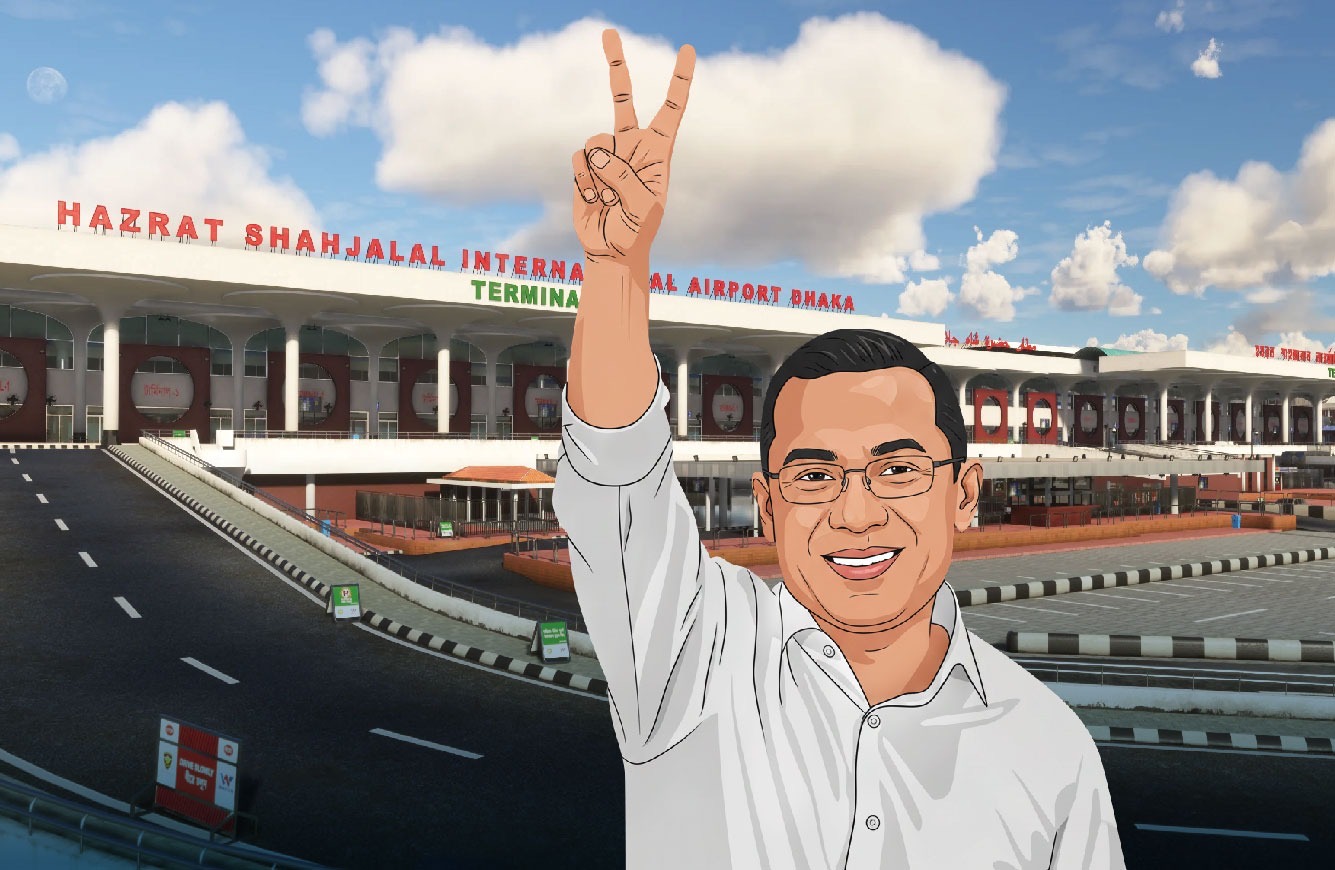
Photo: Aviation Express Digital Art
By Tarek Alif
Bangladesh has voted. A new government led by the Bangladesh Nationalist Party (BNP) has taken charge. And for the first time in years, two long-neglected sectors—aviation and tourism—are daring to dream again.
The BNP manifesto is ambitious, some say audacious. It promises to transform Bangladesh into a regional aviation hub for South and Southeast Asia by 2034. It pledges a National Air Connectivity Grid, structural reform of Biman Bangladesh Airlines, expansion of international gateways, logistics digitalization, sustainable airport operations and aviation universities.
Geography strengthens the narrative. Within two hours lie major South Asian markets. Within four, Southeast Asia. Within six, the Middle East—home to millions of Bangladeshi expatriates. In an era where airspace defines economic power, Bangladesh sits at a natural crossroads.
Yet crossroads alone do not build hubs.
Terminal-3 at Hazrat Shahjalal International Airport was designed primarily to ease congestion, not to function as a true transit hub. While it can handle roughly 16 million passengers and close to 900,000 tons of cargo annually, regional competitors operate at far greater scale and efficiency.
Nearly 80 percent of Bangladesh’s international passenger traffic is carried by foreign airlines. Local carriers operate internationally in limited capacity and utilize only a fraction of available route rights.
Industry insiders insisted infrastructure alone will not create a hub. Policy will.
Aviation: Hub Dream or Policy Reality?
Air Vice Marshal (Retd) M Mafidur Rahman, former Chairman of the Civil Aviation Authority of Bangladesh (CAAB), argued that geography gives Bangladesh a rare opportunity—but operational reform must begin immediately.
His priorities are clear: fully operationalize Terminal-3 with professional, globally competitive ground handling services; initiate construction of a second runway at Hazrat Shahjalal to remove capacity bottlenecks; complete modernization projects at domestic and international airports; and begin planning for a new international airport near the capital under an aerotropolis framework.
“These steps,” he has consistently maintained, “signal seriousness of intent.”
But operators say reform must go deeper.
Domestic Carriers: Backbone of Connectivity
Abdullah Al-Mamun, Managing Director of US-Bangla Airlines, offered a regional comparison that is difficult to ignore. Bangladesh, he noted, lags significantly behind neighbors such as India and China—both with populations of 1.4 billion and rapidly expanding aviation networks.
“Instead of copying Western models,” he argued, “we should follow the examples of India and China, and selectively Singapore.”
His emphasis is on domestic connectivity. Across the region, countries are aggressively expanding airports and internal networks. Bangladesh cannot sustain international connectivity without strong domestic airlines feeding traffic into hubs.
“Without domestic carriers,” he warns, “internal connectivity cannot be built.”
Al-Mamun believes the solution is not export-style subsidies but smart policy adjustments: waive landing and parking charges for domestic carriers; remove VAT on domestic aviation fuel; reduce layered taxes imposed by the National Board of Revenue. Currently, domestic tickets carry around Tk 500 in tax, Tk 500 in excise duty and Tk 200 in travel tax—alongside Civil Aviation charges.
“Even a 50 percent reduction would significantly increase passenger numbers,” he said.
He also highlighted infrastructure gaps. Several divisions and sub-regions remain underserved. Night operations are limited due to absence of advanced navigation systems. “If these policy and infrastructure barriers are addressed,” he said, “Bangladesh can realistically become a regional hub.”
Policy depth vs political rhetoric
Mofizur Rahman, Managing Director of NOVOAIR and Secretary General of the Airlines Operators Association of Bangladesh (AOAB), welcomed the hub ambition but cautioned against impractical expansion.
Turning Bangladesh into a South and Southeast Asian aviation hub is “encouraging and laudable,” he said, though he suggested the Middle East must be included given the size of the Bangladeshi diaspora.
However, he questioned the practicality of building airports in every division and district.
“Bangladesh’s small geographical size does not justify airports everywhere,” he argued. “Only commercially viable airfields should be activated.”
Existing airports like Barisal, Jashore and Rajshahi are already struggling with limited commercial demand. Plans to convert multiple airports into international gateways, he believed, risk becoming political rhetoric if not backed by market viability.
What is urgently needed, he said, is overhaul of the aviation regulatory framework, separation of regulatory and service-provider functions, tariff regime reform and commercial restructuring of Biman Bangladesh Airlines.
On Biman, he is unequivocal. Continuous subsidy, he argued, is “not a policy choice but an injustice to taxpayers.” Privatization or meaningful divestment, similar to Air India’s model, should be openly debated.
“Aviation needs competent people at the helm,” he said. “Policy calibration is urgently required.”
Aviation and Tourism: One Ecosystem
Aviation expert ATM Nazrul Islam believed reform must be integrated. International tourism, he stresses, is inseparable from air transport.
“Without strong aviation, tourism cannot flourish.”
He called for rapid implementation of e-visa and e-gate systems, modern airport management and technology-based solutions such as Advance Passenger Information Systems. Smooth immigration and passenger handling are critical for repeat tourism.
Nazrul Islam proposed developing Dhaka as a primary hub and Cox’s Bazar as a regional “mini-hub,” supported by transit expansion, commercial freedom and adequate aircraft capacity.
Above all, he insisted Biman must function as a commercial enterprise, not merely a state entity.
Tourism: The forgotten giant
If aviation has struggled, tourism has been systematically sidelined.
Tourism directly and indirectly supports millions of jobs in Bangladesh. It connects aviation, hospitality, transport, handicrafts, agriculture and cultural industries. Yet it consistently receives minimal budget allocation and limited policy focus.
Mohammad Rafeuzzaman, President of the Tour Operators Association of Bangladesh (TOAB), believed the new government must elevate tourism to top priority status.
Since tourism was declared a “thrust industry” in 2022, he said, announced incentives have yet to be fully implemented. “All declared benefits must be effectively enforced,” he insisted.
He calls for the introduction of electronic visas (e-visa) to boost inbound tourism and urged diplomatic efforts to withdraw red and yellow travel advisories issued by Western and regional nations.
Rafeuzzaman also advocated for a full-fledged tourism ministry separate from civil aviation, led by experienced professionals. He argued that infrastructure upgrades, tax incentives for private investors, import tax exemptions for tourism equipment and access to low-interest loans are essential for growth.
He further proposed introducing a tourism cadre system to recruit trained professionals into government tourism institutions.
“Tourism was never a priority”
Taufiq Rahman, Secretary General of the Bangladesh PATA Chapter and Founder of Journey Plus, is candid. “Tourism was never on anyone’s priority list. It has repeatedly been ignored,” he said.
Globally, tourism generates massive employment and contributes significantly to GDP. In Bangladesh, however, it has received minimal budgetary support.
Rahman believed that after the ready-made garment sector, tourism could reshape Bangladesh’s global image.
“With proper planning and investment, tourism can contribute to poverty reduction and employment generation,” he added.
Khabir Uddin Ahmed, Founding President of the Tourism Resort Industries Association of Bangladesh (TRIAB), saw tourism as more than travel.
“It showcases our culture and natural beauty to the world,” he said, highlighting emerging opportunities such as sports and golf tourism.
Perception, Coordination and Reform
Syed M. Islam Bulu, President of the Tour Guide Association of Bangladesh, emphasized inter-ministerial coordination. He noted that negative perceptions during the election period have discouraged some foreign tourists.
Taslim Amin Shovon, Director of TOAB, echoed calls for a separate tourism ministry and inclusion of private sector experts in policy-making.
“Policy and structural mistakes of the past must be corrected,” he said adding “Effective implementation will be the real test.”
A Moment of Reckoning
The BNP manifesto speaks of digital logistics platforms, renewable airport energy, aviation universities, eco-tourism circuits and global branding. Stakeholders across aviation and tourism are united in one demand: execution.
Bangladesh stands at a crossroads. Its geography is advantageous. Regional demand is surging. Asia will dominate global growth in the coming decades.
The question is no longer whether Bangladesh can become an aviation and tourism powerhouse. The question is whether the new government can dismantle the systemic barriers that have held these sectors back for half a century.

Make Comment
Login to CommentPopular News





Subscribe to News Letter
Latest News