FACE TO FACE
Sadia Haque, on travel, technology & global ambitions
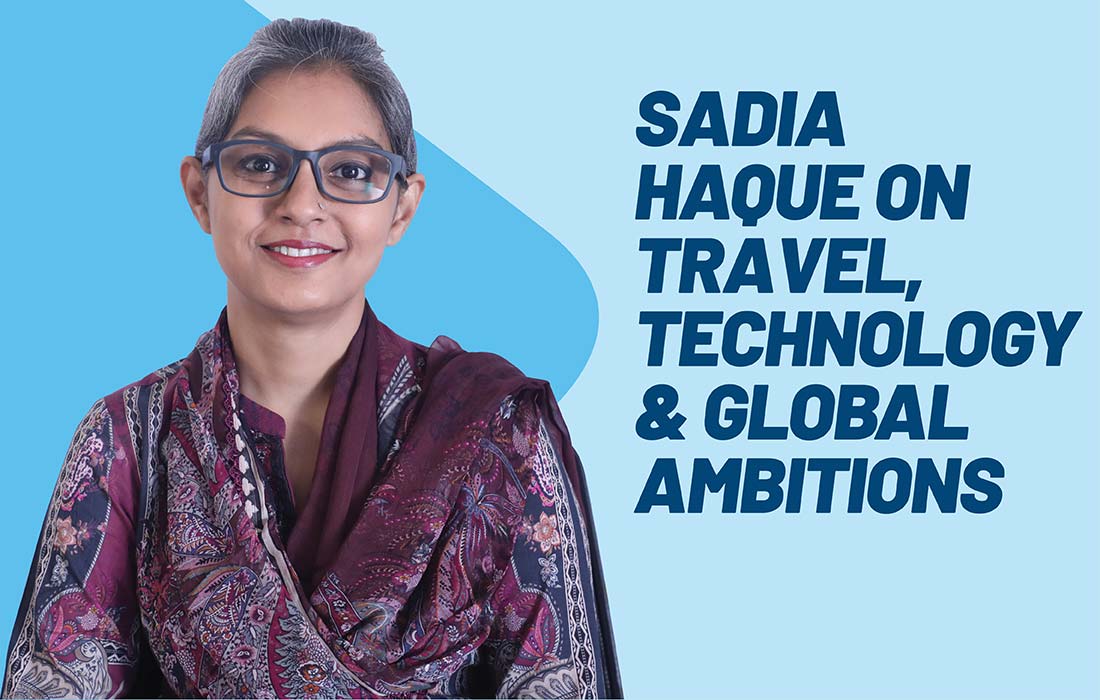
Photograph: Oheduzzaman Titu
As Bangladesh’s travel and tourism industry continues to evolve, technology-driven businesses are playing an increasingly important role in shaping its future. In this exclusive interview with Aviation Express, Sadia Haque, co-founder and CEO of ShareTrip, discusses the changing landscape of the sector, the opportunities ahead for Bangladeshi businesses and the challenges facing the industry. She also speaks about her upcoming role as UNCTAD’s South Asian Advocate for the eTrade initiative.
As you prepare for your formal designation at UNCTAD in Geneva this September, what is your highest-priority objective for your upcoming term as the South Asian Advocate for the UN's eTrade initiative?
Being part of a UNCTAD program as the first Bangladeshi is itself a matter of pride and a big achievement for us as a nation. The core objective is to make South Asian women visible in the data, and then reflect that data in policy execution.
Every policy conversation about digital trade in our region begins with an evidence problem. We cannot conclusively state how many women-led digital businesses exist in Bangladesh, what they earn, their taxable income, how much of the cross-border trade they carry, or where exactly they stop growing. What we have instead is anecdote and a few good surveys. When policymakers are presented with these, there are no effective solutions to assist these women entrepreneurs.
So my first priority would be to address this area, build our own statistical institutions and the region's associations to establish a baseline: who these businesses are, what they are worth, and precisely which regulatory step they fail at. Along with this, there are other burning issues like payment gateway access, cross-border settlement, the collateral requirement on a working-capital loan, and the identity and licensing requirements that assume a male head of household; these are all areas that need to be addressed urgently if we are to bring leverage to the women in the digital economy space.
You have noted from your own experience that building a successful technology enterprise requires far more than just a good idea — it demands access to networks, capital, knowledge, and a highly supportive ecosystem. In your regional advocacy role, how do you plan to bring these critical environmental challenges into high-level policy conversations?
Over the last couple of years, the term “investment winter” or “capital deficit” has become common in conversation for any entrepreneurs/startup founders. These are tied to networking, experience sharing and enhancing technology know-how. These are all vital metrics for any entrepreneur to flourish and grow.
In Bangladesh, we are seeing how all these areas are taken into importance, and relevant policies are being amended, created, and that’s about it. There are still gaps in guidelines for the disbursement of the allocated funds, no measurement of the training modules that are being implemented, and the list goes on.
I would sincerely like to take these primary factors into account and see to their implementation through platforms like UNCTAD. The global economy is moving quickly, and we cannot afford to fall behind. Unless we move at the required pace to position ourselves in the competitive landscape, we will fall short of everything.
You have commented that to drive real progress for emerging leaders in the digital space, we need "more execution and fewer hashtags". What does a meaningful, action-oriented execution roadmap look like for the digital trade ecosystem in late 2026?
For any entrepreneur operating in the digital trade ecosystem, the building pillar of the portfolio needs to be results and data. Looking into the roadmap by the end of 2026 is a narrow window, as the work required is far too diverse and long-term.
As humans, we always like to see quality and successful ventures. But the reality is quite different from what we envision. Over the last couple of years, we have had to face multiple shocks, national and global, which have caused many businesses to set back and take a pause.
We have realised that as business owners, there cannot be any pause or break, and that is where the action-oriented execution comes into play.
We need to create those marks showing our resilience, belief, vision and adaptability. All these can only prove something when there are action-oriented outcomes to whatever and wherever we are operating. The trade can only sustain itself if there is a supporting ecosystem to support it.
The ease of doing business, the cost of being compliant, and the eligibility criteria for running a woman-led enterprise all need to be adaptive just like the entrepreneurs themselves. Finding the right match amongst all will be the clear indicator of the action-oriented roadmap and result that we dream of.
The Prime Minister recently indicated that steps are underway to let Bangladeshi diplomatic missions abroad actively support local tech firms seeking overseas expansion. How does ShareTrip plan to coordinate with these foreign missions to accelerate your international footprint?
The startup ecosystem is still at a very early stage if we compare it with other countries that prioritise this sector. Such statements bring a lot of confidence for us; it feels like all the hard work has started to pay off as we are now being recognised by the top leadership of the Government, who are committed to helping us expand and sustain.
The bilateral and geopolitical mandates can aid significantly in regional or global expansion. We see many companies with the potential to expand regionally, but the challenges become stronger than the opportunities. For ShareTrip, we hope to work on these areas by gaining commercial and market intelligence from missions, building multilateral relationships, and consequentially place Bangldesh origin companies like ShareTrip in overseas markets. In regard to the matter of how and when these will be in fruition is still something that we are all working on collectively as an ecosystem.
ShareTrip is one of the very few travel platforms globally with direct integration into Saudi Arabia's Nusuk Masar system. How has this direct integration altered your platform's capabilities and competitive advantage in the high-demand religious travel market this year?
Bangladesh market ranks as one of the highest senders of pilgrims to Saudi Arabia. The market is undoubtedly huge, but at the same time, there is a lack of efficiency, transparency and also service quality.
Being the only travel agent from Bangladesh as the Official Partner of the Saudi Ministry of Hajj and Umrah, including the Nusuk Masar platform, shows the potential and capability of Bangladeshi companies to make a mark on the global stage. The Saudi’s broader digital transformation of the Umrah journey is a mirror reflection of what ShareTrip has been advocating and working towards from the first year of its operation in Bangladesh.
Any sort of digital integration and direct connectivity brings competitive advantage alongside it. Our objective through this partnership is not to be a competitive, price-point player; rather, we want to change the traditional way of operation for the Umrah Services and build on the mandates of Saudi Tourism that go hand in hand with the Umrah Experience. Since ShareTrip has always been technologically advanced and adaptive, the integration was executed seamlessly and in accordance with the Saudi Ministry’s guidelines. This not only helped ShareTrip to gain confidence from the Saudi Ministry but also sent a very positive and progressive message of how the travel and tourism dynamics of Bangladesh have evolved.
As digital payments scale rapidly, how does holding a travel wallet licensed by Bangladesh Bank (ST Pay) enable ShareTrip to build a more closed-loop, frictionless booking experience for travellers?
This is a very interesting area to explore, and the opportunities are endless for any company to have its own digital wallet. For any tech-savvy person in Bangladesh, the usual journey is to have multiple service apps for his/her daily use and requirements. The objective is to build an inclusive ecosystem that caters for most of the customer’s needs.
While we are getting used to managing multiple platforms, the next generation wants a one-stop solution to all their needs. This is where ShareTrip and ST Pay can make the difference. The complete journey from choosing a service, payment, adjustments to payment, etc can be done digitally and in a much shorter time frame. If this practice develops, the journey to a cashless society becomes one step closer.
Every pro comes with a con. The regulatory and policy guidelines for Digital wallets are still quite restrictive and non-operative for larger, high-ticket transactions. While we intend to move towards a cashless society, we need to start making amendments to these policies and guidelines which will encourage more people to opt towards digital transactions, making each transaction traceable, accountable and most importantly documented.
Following the sudden collapse of several Online Travel Agencies that vanished with customer funds and created a crisis of confidence, how is ShareTrip working to restore trust and guarantee consumer financial security across the wider digital travel market?
The basis of any organisation is establishing ethical business practices. We are extremely proud and confident in stating that ShareTrip has always been operating its business while maintaining ethical practices, following the laws of the land and regulatory guidelines. These basic principles help to build trust and confidence among the end users. It is a fact that such incidents create an unwanted burden on other existing companies; however, in spite of all the negativity and wrongful doings by others, we have been blessed by the support and loyalty of our end users.
The biggest asset that we have built over time is the credibility of our brand, service and the extra edge that we always try to maintain for our users. Backed by foreign investment from globally renowned institutions and having transparent and public information about the company’s profile and growth has helped us to maintain our existence in the country. Additionally, ShareTrip is recognised and appreciated by cross-functional industries, ranging from the banking and financial sector to global and local conglomerates, which provides added value to gain the customers’ trust. Financial security and transparency have always been a critical aspect for the travel and tourism sector, which is why we constantly rely on digital payments and transactions through reliable banking partners and non-financial institutions, like MFS players. This ensures traceability of each transaction while ensuring accountability. Throughout our journey, we have always tried to educate and make customers aware of choosing the right partners with the right profile and background.
Do you believe Bangladesh needs a dedicated regulatory policy for OTAs to protect consumers, prevent fraud, and create a more conducive environment for legitimate businesses? What should be its key provisions?
There is a current policy already in action that provides regulatory guidelines for all agents. We don’t necessarily need another layer of regulation; we need better enforcement, transparency and accountability across the industry. We operate in a different modality, not in a different industry or catering to different people. If you consider any industry, a general difference is seen between the earlier established companies and the newer versions of the companies in the same industry. Based on business modality, new regulatory guidelines create more complications rather than safeguarding anyone. In reality, what is needed is to be vigilant, to be aware of who is doing business, how they are doing business and on what grounds. The information and resources are so readily available now for everyone; it does not take much to do a self-study before deep diving into commitment. The regulatory body needs to hold the responsible people/companies accountable and make it public for others to be aware and cautious. We start by generalising everyone as being of the same nature, which tarnishes the reputation and credibility of established and recognised companies like ShareTrip.
You have advocated for a streamlined e-visa system to support tourism, and the government has discussed launching a Tourism Satellite Account. How will these policy mechanisms help measure and accelerate the travel industry's true contribution to Bangladesh's GDP?
Foreign tourist earnings actually fell between 2023 and 2024 while comparable neighbours grew significantly. This is where we see the opportunity to fast-track our global position.
The e-visa is about encouraging and making foreign visitors' entry to Bangladesh smooth and enjoyable. Bangladesh currently ranks near the bottom globally for foreign arrivals, and our foreign tourist earnings actually fell between 2023 and 2024 while every comparable neighbour grew significantly. That is not because our assets are inferior. We have the world's longest natural sea beach and the world's largest mangrove forest, a UNESCO World Heritage site. It is because the friction of arriving here is higher than the friction of going somewhere else. A traveller deciding between Bangladesh and Sri Lanka is comparing a consular process against an online form. We lose out in the very early stage of connecting with visitors and spreading a message globally that marks our nation as a potential tourist destination. A functioning e-visa is simply not a convenience measure — it is the precondition for competing amongst all.
The Tourism Satellite Account is about measurement, and it is closely related to the concept of bringing in tourists. Tourism spending is currently scattered across transport, accommodation, food service and retail in the national accounts, so the sector effectively disappears. A sector that cannot be measured cannot be prioritised, cannot be given a credit line, cannot be argued for in a budget. The government has set a target of raising tourism to six or seven per cent of GDP. You cannot manage toward that target without first being able to count it, and the BBS work on the Satellite Account for 2026–27 is the instrument that makes counting possible.
Platforms like ours have a role to play here too. The OTAs hold real-time data on domestic travel demand, seasonality, route patterns and price sensitivity that no survey can match. If we can collaborate and merge data to make it concrete and verifiable, the correct strategy and appropriate measures can be taken to reach the national tourism contribution to the economy.
You have voiced that tech startups need supportive regulation and an ecosystem that treats young companies as partners rather than rivals. How can established, traditional aviation and hospitality players be persuaded to collaborate with digital disruptors?
The core challenge is the fear of technology and adaptability. Tech-driven companies have proven how greatly they can contribute to the industry while bringing multiple value additions. The conflict arises when we start differentiating between tech-driven companies and companies with a traditional mode of operations. The same applies to the travel and tourism sector.
To survive in the global arena with so many technology-based developments, AI automation, data infrastructure, digital payments, etc, we ideally should not shy away from this space. Our demographic dividends are the largest asset we have, and they can only be capitalised if we encourage them to contribute to the progressive economy. This can be done when there are more changes within the industry from the old-school operational mode to the new-school thought process.
The neighbouring countries have advanced with digital disruptions in major ways across all industries, yet we are being inconsiderate of how those radical changes are going to affect our industry while we lose out on our core strengths. There is no alternative other than being technologically enhanced, and it can be done in multiple ways, not just by building an OTA. We have to increase our appetite as a whole and work on those areas. Direct collaborations with other tech solution providers make our business stronger and long-lasting. It helps us to gain a competitive edge not only within our country but globally. The goal for each industry as a whole should be aligned with this principle.
ShareTrip was a pioneer in introducing automatic refunds, cancellations, and date changes. Building upon your recent additions like Travel eSIM, Flight Alerts, and delay protections, what is the next frontier of frictionless travel technology you are developing for late 2026?
ShareTrip thrives on being innovative and ensuring superior customer service at all levels. Our goal is to make the journey effortless and convenient. The current service portfolios that we have introduced are all reflections of that commitment. In the coming days, there are many more areas to cover, all of which will enhance the quality of life for our valued customers. The vision for ShareTrip is not to be complacent, and in the coming days we will work focused on this vision. Some key areas that we are working on are predictive travel assistance and curated personalised travel journeys, all of which require deep tech involvement and high R&D. We believe in not over promising rather living up to our promises in delivery.

Make Comment
Login to CommentPopular News



Subscribe to News Letter
Latest News